
Hunting & Heritage
|
09/10/2026
Anatomy of a Hunting Accident
No matter how careful you are, be more careful
by Jim McLennan
Related Articles


In fall of 1988 I returned from my first steelheading trip to British Columbia, dried out my waders, packed away the tackle and switched back to my standard autumn obsession, which is hunting birds.
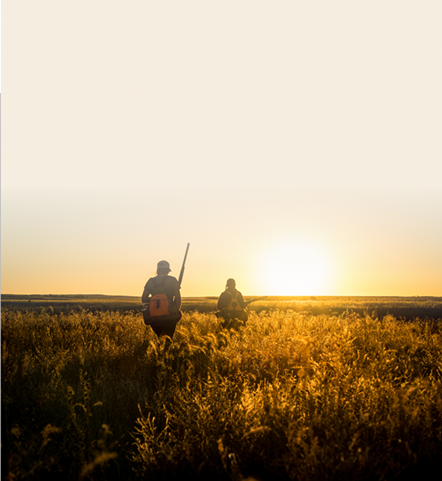
Two companions and I traveled to a friend's ranch in southwestern Alberta in mid-November for a combo grouse/duck hunt. After we wore the dogs out on the mostly uncooperative sharptails, we got ready to try for mallards on a small spring-fed pond. The pond is a late-season duck-magnet because it stays open after all the main water holes in the area freeze.
We hurried to be ready at the edge of the pond shortly before dusk. I didn't own a duck gun in those days, but my friend brought me a 12-gauge autoloader to use.
Just before we got into the blind he handed it to me, but for some reason I couldn't figure out how to operate it properly. We could hear the ducks on their way in, so we quickly traded guns and I took his other one, a Browning side-by-side 12 that he had planned to use.
The ducks came — fat, late-season, grain-fed mallards. A single drake set its wings in front of me. My shot knocked it down and it fell in the tall grass near the water. I removed the empty shell and put another one in the chamber, trotted over to pick up the duck, and hurried back to the blind.
A pair of ducks came in from behind and to my left, crossing diagonally down in front of me, and I remember thinking that it was an unusual and interesting angle for a shot.
I pulled the trigger and the gun belched a deep, thumpy boom, then jumped from my hands and landed on the ground in front of me. I felt a buzz in my left hand, looked down and saw that the ends of my last two fingers were gone. One of them showed white bone where skin used to be. I covered the hand with my other glove and did not look at it again.
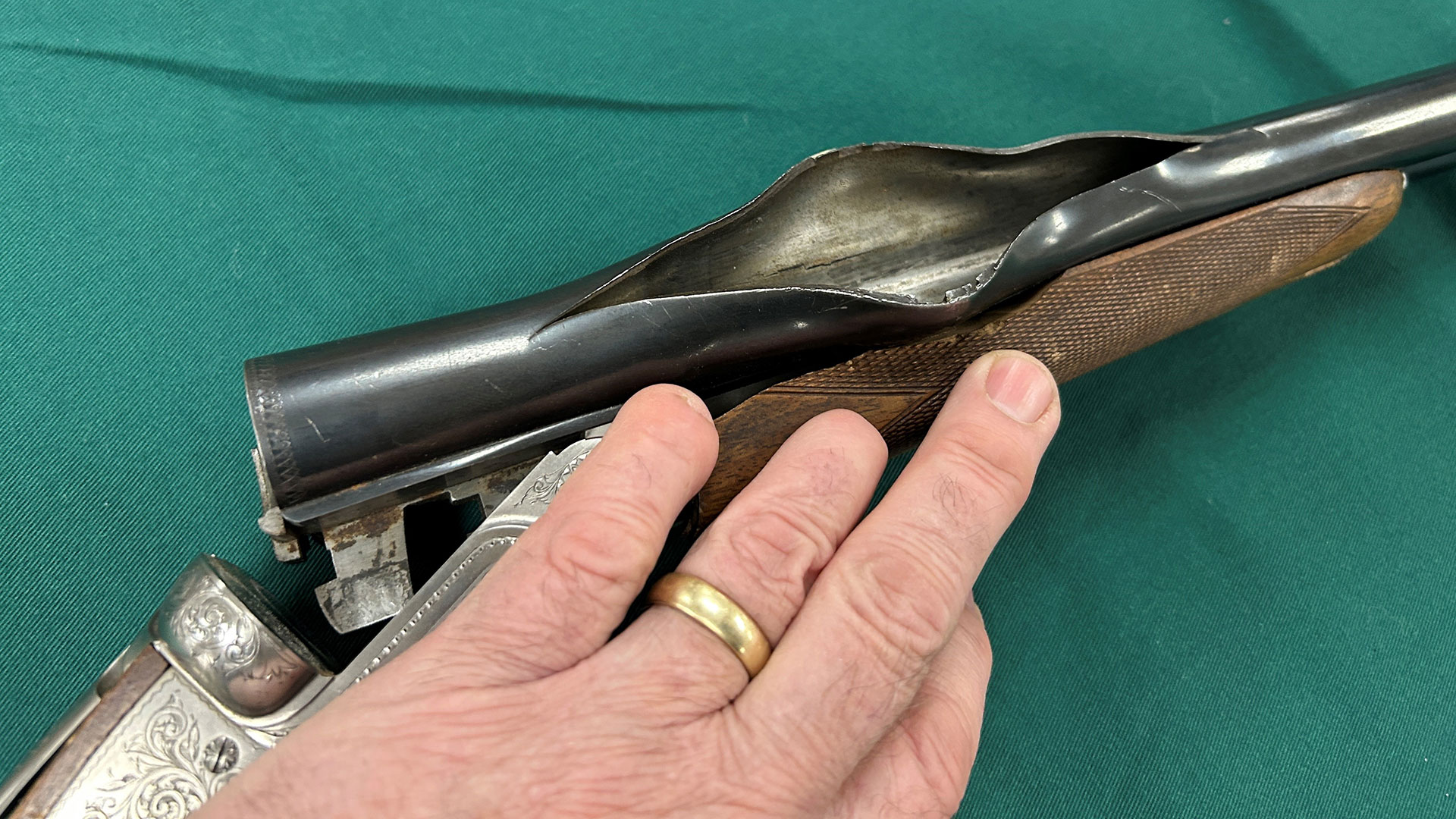
"I felt a buzz in my left hand, looked down and saw that the ends of last two fingers were gone."
We jumped in the pickup and raced for the hospital about 40 minutes away. The pain wasn't bad initially. But 20 minutes into the drive, it was nearly unbearable.
At the hospital, the emergency doctor immediately hooked me up to an IV drip with some morphine, and the pain subsided to almost nothing in about a minute. He cleaned, stitched and bandaged my hand.
Then we tried to figure out what had happened. All I knew was that the gun had exploded when I pulled the trigger.
Awhile later an RCMP (Royal Canadian Mounted Police) officer came to see me in the hospital room because local police are required to investigate any incidents involving guns. He came with the news that the gun had exploded because there was a 20-gauge shell stuck in the barrel ahead of the 12-gauge shell.
I was stunned. Through my whole shooting life I'd known of the danger of firing a gun with a barrel that's plugged with snow, mud or dirt.
My dad taught me to be especially careful not to get 20- and 12-gauge shells mixed together. If a 20-gauge shell is put into a 12-gauge chamber, it slides in but doesn't go all the way through the barrel. It goes in just far enough to be out of sight, then stops and lodges in the narrowing part of the barrel, leaving space for a12-gauge shell to be dropped in behind it. When the trigger is pulled the 12-gauge charge has nowhere to go and forces an exit out the side of the barrel.
That was exactly what happened. But I had no idea how the 20-gauge shell got into the gun. I had taken off my upland vest containing 20-gauge shells and put on the duck-hunting coat where I'd put the 12s, precisely to prevent any chance of this happening. But it had. How?
After much thought, I recalled sorting my shells prior to the trip. There were some that my dad had given me a few years prior, when he stopped shooting — some re-loads and old factory loads, 12s and 20s, all mixed together in a cloth bag. I separated them and put them into 25-unit cardboard shell boxes.
The unavoidable conclusion was that I had mis-sorted the shells at home and put a 20-gauge shell in a box with 12s. From there the rogue shell made it into the pocket of my hunting coat and finally into the chamber of the gun.
Then I recalled that after I shot the duck, I immediately dropped a new shell into the right chamber before I retrieved the bird. And I remembered being momentarily surprised to see that the chamber of the gun was empty when I got back to the blind. I assumed the shell had bounced out when I bent over to pick up the duck. But it hadn't. It had slid down the barrel and stayed there. With all the chances I had to notice a single 20-gauge shell, why hadn't I?
Later the RCMP officer told me something odd.
"The shell in that gun is the only red 20-gauge shell I've ever seen."
Red? A red 20-gauge shell? I didn't know they existed, and I sure didn't know I had any. But that had to be it. There must have been a red 20-gauge shell in with the red 12s, and it traveled unnoticed all the way from my basement to the barrel of the borrowed gun.
I should have spotted it at some point. But because the size difference is slight and the colors were identical, I hadn't. Perhaps I wasn't as vigilant because I didn't know that the possibility of such camouflage existed.
Even in 1988, red 20-gauge shells were rare. An Internet search told me: "Red plastic 20-gauge shotgun shells essentially ceased production between 1961 and 1968. Twenty-gauge shells are almost universally yellow for safety to prevent them from being accidentally loaded into 12-gauge shotguns, which can cause the catastrophic '12/20 burst.'" My Dad had a lot of old stuff in the basement.
A short while after the accident I looked at the shells I had in my basement, including more of Dad's hand-me-downs. There, in a cloth bag with a bunch of standard red 12-gauge shells, was another red 20. A chill ran up the back of my neck. I wrapped a big piece of duct tape around the shell, and put it in a drawer as a sort of dark souvenir. It was the last one I ever saw.
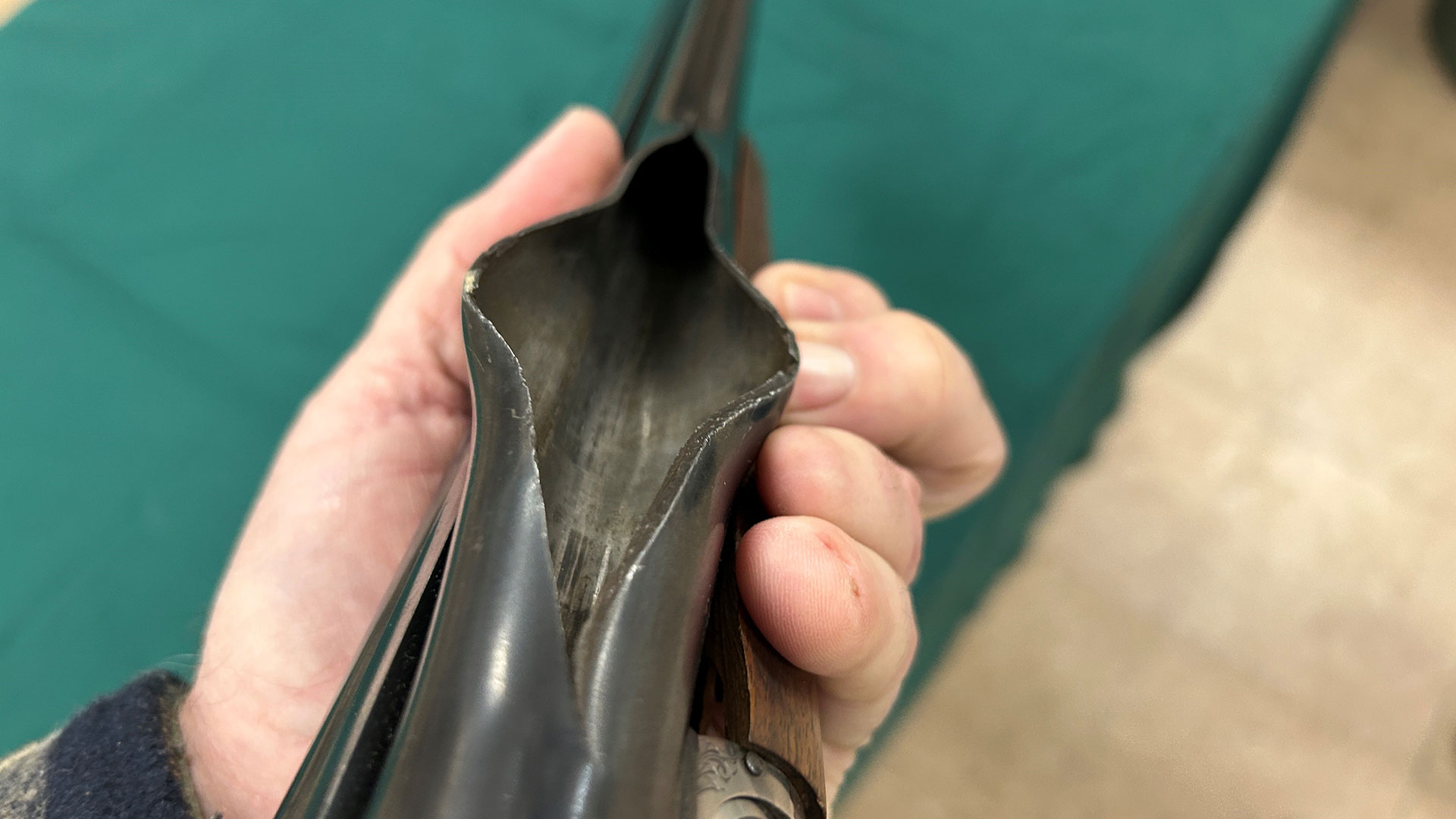
At home, my hand recovered from the wound with no particular effects on my life, except for my guitar playing, which was set back a few years but not eliminated.
And it could have easily been much worse. If the whole episode had occurred in the left barrel of the side-by-side, the burst would have taken my thumb. Had it happened in the autoloader I was intending to shoot, the blast might have come back into my face rather than out to the side.
In the weeks that followed, not surprisingly I thought about this a lot, considering possible lessons. I even talked to my pastor about it, asking if he thought God was trying to tell me something.
"Yes," he said. "I think He's trying to tell you to be more careful with your shells."
I believe it's every hunter's imperative to be the safest hunter they know. I considered myself that before the accident, and still do. But something unusual, something so weird that no one could have predicted it, still happened.
Maybe the most important lesson is the simplest: No matter how careful you are, be more careful.
I also wondered in those weeks if I'd be able to shoot again, if the experience would leave a deep enough scar in my head to bring on the "yips," flinches, or an involuntary refusal to pull a trigger.
Two weeks after the accident, with my hand still bandaged, I took my Brittany, Spud, out to some nice Hun country near home. He was my first dog, notable for his personality and sense of humor, less so for the virtuosity of his nose.
That day I lost him in the field for awhile, which was unusual, and finally found him standing proudly on point — which was even more unusual — in a bit of rough cover running through a grain-stubble field. I walked in front of him, induced a beautiful covey-rise, raised my 20 and missed. Twice.
I was annoyed, and railed at my lack of skill in such a perfect setup. But then I thought: Hey, but I pulled the trigger!
We followed the covey up and I shot a single Hun. Thank you, Spud.
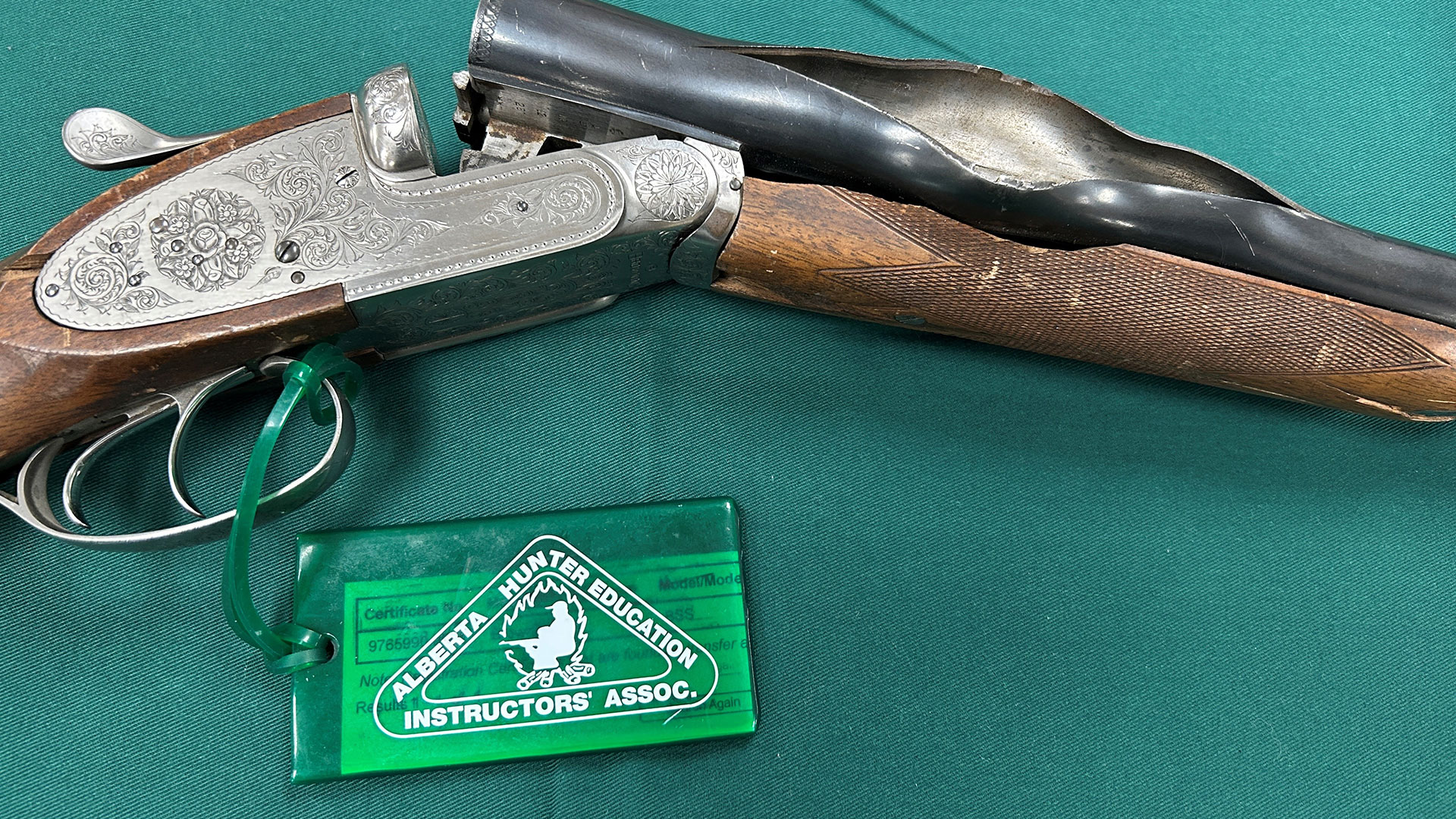
What remains of the 12-gauge side-by-side now resides in a hunter-training center, where it is used to show young shooters the frightening results of mixing shells. Though it probably should, it doesn't hang beneath a sign reading, "Here's what Jim did. Don't be a Jim."
I check my gun barrels for obstructions 20 or more times a day: every time I open, close, or load a gun; anytime I think the muzzle might have come near the ground; and randomly "just because." I've done this every day in the field since 1988 and never found a problem.
But I'll keep checking.

Your cart is empty