
Hunting Forecast
|
09/14/2026
Pheasant Hunting Forecast 2026
Pheasants Prove Their Mettle, Should Be a Good Fall
by Tom Carpenter


The magnificent ring-necked pheasant never ceases to amaze.
Winter blizzards. Spring monsoons. Summer thunderstorms. Prolonged drought.
Our namesake bird has the mettle to survive it all.
The pheasant range is a big place — 22 states covered, in fact, in PF’s annual Pheasant Hunting Forecast — and everywhere is different.
There’s plenty of good news in here. Last winter was easy on the birds most everywhere. Nesting season conditions varied from wet to dry. But the hens, mettlesome creatures they are, hatched and raised new broods.
Take a tour of pheasant country in our annual hunting forecast. Places you are going. Places you want to go. Places that need not be a dream. The autumns of our lives are numbered.
And as you hunt this fall, remember the one thing pheasants cannot survive: a world without habitat.
Then commit, or re-commit, yourself to the Pheasants Forever mission.
For you have mettle too.
— Tom Carpenter, Editor
Select a State
California
Pheasant Hunting Forecast 2026 - California
California Roosters Will Provide Opportunity
By Andy Fondrick
Golden State roosters experienced a wide range of conditions over the past year. Unseasonably warm winter months followed by some timely weather events may have provided reprieve at opportune times.
The state's usual pheasant hot spots should provide opportunity for hunters to follow the dog and flush a few roosters again this season.
While weather patterns and habitat conditions can vary greatly across California, there is reason to believe that upland birds may have been able to take advantage of timely conditions through winter and spring.
We tapped the staff at the California Department of Fish and Wildlife (CDFW), specifically Upland and Small Game Biologist Matt Meshriy, to help us look at what hunters should expect when taking to the field in the Golden State this fall.
Weather and Conditions
California upland birds experienced an above-average winter again this year, and that should have provided pheasants that survived the hunting season with a leg up.
"The winter of 2025-26 was among the warmest on record in California," says Meshriy. "The month of March set the all-time records for average heat across much of northern California. Precipitation was at or above average in November and December. But with the new year, conditions turned warm and dry. A few well-timed April storms provided some snowpack and improved the spring green-up."
Meshriy went on to add that summer conditions were unusually mild through August, with increasing monsoon activity picking up during late summer. He noted that habitat conditions should be fair overall for pheasants and other upland gamebirds.
Hatch and Broods
While California doesn't conduct roadside surveys, Meshriy was able to provide a little insight into the 2026 hatch and brood rearing conditions a little more anecdotally.
"Low winter snow and cool spring conditions favored overwinter survival for pheasants," he said. "But varying regional precipitation, water deliveries and pheasant population levels well below historical average, mean that conditions are dynamic at the regional and local level."
No different than any other year, doing some pre-scouting and homing in on areas where weather reports suggest favorable stretches will go a long way in finding more wild birds.
Top Spots and Insider Tips
When asked to provide a "top three" of areas to start when planning a pheasant hunt in California, Meshriy called out a few areas.
"The Sacramento Valley is the stronghold for pheasants in California," he said. "Top counties for successful pheasant hunters include Colusa, Yolo and Butte Counties."
With such a large state to cover and so little time to do it each fall, don't be afraid to jump on hunting forums or social media groups to get some insider information on hotspots that may pop up throughout the season.
There is no better recipe than loading up the truck, keeping the wind in your favor and putting on miles behind an ambitious bird dog!
Season Details
Dates
November 14 — December 27
Bag Limit
2 Roosters for the first two days of the season
3 Roosters thereafter
Possession Limit
Triple the daily bag
Colorado
Pheasant Hunting Forecast 2026 - Colorado
Colorado Ringnecks Hold On Despite Drought
By Josh Tatman
Colorado just suffered one of the driest water years in recorded history. Paltry snowpacks, extremely low streams, and mountain wildfires, have plagued Colorado this year.
While the state isn't famous for pheasants, plenty of wingshooters live in Colorado, and a decent number travel from elsewhere to chase roosters on the plains.
For these hunters, dry weather will make the upcoming pheasant season challenging, but there will be some birds for those who work at it.
Weather and Population Trends
Trey McDowell is PF & QF's private lands conservationist in southeastern Colorado. He says, "Most of the pheasant range has been in drought for much of the nesting season, and emergency grazing was authorized on CRP acres early in the spring."
That doesn't sound good. But McDowell is hopeful nonetheless.
"There are some things to be optimistic about," he says.
First, "We didn't see huge CRP plow-outs this year, so the habitat we had from last year is still out there." Any bird hunter worth their salt knows that good habitat grows pheasants, even in a down year.
Second, "I have been seeing some broods and some good habitat. There are some Walk-In Area (WIA) properties in the eastern part of the state that will be productive."
Josh Melby is a Colorado Parks and Wildlife (CPW) wildlife manager in northeast Colorado. He is quite optimistic about the pheasant season ahead.
"We had good over-winter survival as indicated by spring crow counts," Melby says. Even though drought affected the region, Melby reports at least variable nesting cover. "We had good late rains, and there were only a few big hailstorms, mostly in the Sterling area."
Pheasant hunters shouldn't expect big bird numbers on the High Plains. But CPW wildlife officers and landowners are reporting roadside pheasant broods, suggesting some localized nesting success.
Where to Hunt in Colorado
With very few public hunting opportunities left on the Front Range, most of Colorado's rooster junkies travel to the eastern part of the state. Josh Melby outlines the two primary hot zones for both locals and non-residents. "Northeast Colorado has good WIAs, especially in Yuma, Logan and Phillips Counties. However, these areas also get the most pressure."
If you hunt off Highway 6 and Highway 34, you are bound to see some competition. Most hunters can pick out good pheasant habitat, so try walking the more mediocre spots. People drive by a lot of birds on their way to the best-looking covers.
Southeast Colorado is more remote, and consequently sees less hunter traffic. There are plenty of WIAs to choose from around Springfield, and further north on the Arkansas River corridor. Still, with the overlap of wild quail and pheasants, don't expect to have southeastern Colorado's lonely plains all to yourself.
Western Colorado also has wild pheasants along the Gunnison and Colorado River plains. A trip to the warm wine country on the westslope could make for a memorable hunt.
Wherever you choose to hunt it won't be a banner year for Colorado pheasants. But expect these tough birds to buck the drought conditions. Just get out and hunt.
Season Details
Dates
East of Interstate25: November 14 — January 31, 2027
West of Interstate 25: November 14 — January 3, 2027
Bag Limit
3 Roosters
Possession Limit
9 Roosters
Idaho
Pheasant Hunting Forecast 2026 - Idaho
Drought Will Make Idaho Pheasant Hunting a Challenge
By Jack Hutson
Habitat — cover, food, water — has the greatest influence upon all wild creatures. The better the habitat, the better the conditions for survival.
If only it were that simple.
To complicate things, habitat and the pheasant's most critical period of the year — spring and summer recruitment of young birds — depends greatly on the weather. The number of birds that survive winter's severity are then tested by spring and summer's generosity (or lack thereof).
With respect to nesting and brood-rearing success, weather becomes habitat's equal in importance.
In northern Idaho's Region 2, Idaho Fish & Game (IDFG) wildlife biologist Nathan Floyd offers his weather assessment: "Winter carryover appears to have been favorable. In much of Idaho's northern agricultural pheasant country, December through February was approximately 5°F warmer than average."
"Upland bird survival should have been reasonably good, going into spring," reports Floyd.
"March and April were wet but mild, which supported early vegetation growth."
"However, the nesting and brood-rearing conditions were mixed," Floyd says. "The relatively warm and less rainy weather around the primary hatch period may have reduced chick losses associated with cold, wet conditions. The tradeoff is that the extremely dry conditions later likely shortened the availability of green, forb-rich cover and the associated insect production needed by growing chicks."
Idaho's drought status has deteriorated throughout the state's southern pheasant-producing regions. In fact, the entire southern portion of Idaho is in Extreme to Exceptional drought status.
Even desert-dwelling sage grouse are finding it difficult to contend with the drought conditions.
"Going into the brood season, southern Idaho weather conditions were similar to the dry conditions experienced in 2025 across much of Idaho," says Jeff Knetter, leader of IDFG's upland bird management program. "In general, fall 2025 saw a considerable drop-off in harvest for most Idaho upland gamebirds compared to an exceptional upland game bird year during 2024."
2026 could be equally as tough as 2025 for pheasant hunters.
Nick Gailey has been heavily involved in regional habitat projects organized by the PF Upper Snake River Chapter. He has noted a recent decline in pheasant numbers in southeastern Idaho — especially birds of the year.
"Last year, of the pheasants I was able to harvest, over three-quarters of them were second or third-year birds," Gailey recalls. "So far this summer we seem to have good broods of California quail, but the pheasant population seems to be down even compared to last year."
From the south-central portion of the state, Pheasants Forever Coordinating Wildlife Biologist Pratt Griffeth says, "Bird numbers were down last year from the previous year. I believe the drought conditions hit broods hard last year, as there were few insects to support them." He says this year offered similar challenging, dry conditions.
Also reporting from south-central Idaho, IDFG Wildlife Biologist Brandon Tycz longs for better days. The exceptional season of 2024 is a reoccurring comparison … proof that, so often, the stars don't align.
"When all the variables don't line up perfectly, the bird numbers usually remain stable or decline," Tycz explains "This spring's lower than average moisture and, therefore, the less robust growing season, didn't develop a landscape conducive to good upland bird reproduction this year."
Gailey agrees: "The drought in southern Idaho has made cover conditions for nesting and brood protection very challenging."
Griffeth offers one bright spot: "Yes, this year has been dry, with a record-low snowpack reported in many places. But we have been blessed with some timely rains. Though I think that bird numbers will be slightly lower than the 5-year average, there will still be birds to chase."
But will they be pheasants?
Knetter sums up the situation: "Given the weather over the last 7 months or so, I think wild pheasant production will likely be down again this year."
"I am not optimistic that upland game bird hunting will come close to the fall of 2024," he says. 2025 was challenging. This year may be even more so.
The good news is, when it comes to upland game birds, Idaho is as diverse as its landscape. With pheasants included, there are 9 huntable species of upland birds to hunt here. And two-thirds of Idaho is comprised of federal or state public lands.
"Idaho is one of a very small list of states where hunters can reasonably locate all three species of forest grouse — dusky, ruffed, and spruce, and two species of prairie grouse — Columbian sharp-tailed and sage-grouse," says Knetter.
"Idaho also offers some of the best chukar and gray (Hungarian) partridge hunting in the West, he adds, "not to mention robust populations of California quail."
To finish with a focus back on pheasants: Drought is going to make this a challenging year for pheasant hunting in Idaho. Local pockets of prime pheasant producing habitat is most often found on private property. A polite request could be the key that unlocks the gates.
SEASON DETAILS
Dates
Youth Season: October 8 — October 14
Resident Season: October 15 — December 31
Nonresident Season: October 20 — December 31
Shooting Hours
Check regulations that vary by property type and region.
Bag Limit
3 Roosters (2 rooster pheasants on designated WMAs where birds are released)
Possession Limit
9 Roosters
Notes
New this season, pheasant regulations are statewide.
Illinois
Pheasant Hunting Forecast 2026 - Illinois
Promising Nesting Season Makes Lots of Illinois Roosters
By Mikayla Peper
Chasing roosters in the Land of Lincoln means finding the right pockets if you're hoping to bag a bird or two.
Pheasants were treated pretty well by the weather this past year, meaning you will have decent odds of finding birds if you can get to a good spot.
Observations around the spring nesting season particularly make it sound like this coming hunting season will be a blast.
Weather and Conditions
Hunter Anderson, Pheasants Forever Farm Bill biologist in east-central Illinois, reports on the past year in his area.
"We saw quite a bit of snow in December," he says. "I think that provided some good moisture for spring. Many birds were very active in the spring, more than I've seen in the past few years actually."
Furthering this observation is the Illinois Department of Natural Resources' Ag and Grassland Wildlife Program Manager, Don Kahl.
"Outside of a three-week cold snap in January, I would say this winter was pretty mild across the state," Kahl says.
"It's not official yet," Kahl adds, "but early indications from our team's annual upland bird report say a solid number of pheasants made it through the winter and into the breeding season."
Storms passed through the area in the spring, potentially affecting nesting success in some areas.
"Despite a few challenges, I think nesting and brood conditions were good," Kahl noted. That's great news.
After nesting, birds were greeted with dry conditions … a pattern with both good (warm for chicks trying to thermoregulate) and bad (perhaps not as many insects produced for forage).
"Yes, the beginning of summer was a bit dry, but July brought back some rain thankfully," Anderson reports. That can be a very positive pattern for birds. "And we had solid numbers of birds even before then. I saw roughly 100 birds within one square mile in the early spring."
Anderson also mentioned that wetlands throughout east-central Illinois have done an excellent job of providing insects for chicks.
Hunting Season Prospects
The transition to fall will be telling for how rooster numbers look come hunting season.
"The current dry weather would not be ideal" for hunting, Anderson says. There is lots of time yet, though, before pheasant season opens. Anderson is already longing for that first snow of the year. "That snow should help to keep the birds in place for people to harvest, so I hope we see that come our way," he says.
Despite the number of roosters harvested being relatively flat the past few years in Illinois, birds can still be found if you know where to look.
"Hunters can still find pockets of fair hunting where quality habitat exists," Kahl describes.
Anderson encourages people to look throughout east-central Illinois, specifically in Champaign County and surrounding areas.
Season Details
Dates
November 7 — January 8, 2027 / North Zone
November 7 — January 15, 2027 / South Zone
Bag Limit
2 Roosters
Possession Limit
6 Rooters
Notes
Learn about Illinois' controlled hunt program here.
Indiana
Pheasant Hunting Forecast 2026 - Indiana
Indiana Pheasant Numbers Should Be Good
By Mikayla Peper
The Hoosier State faces two limiting factors for pheasant hunting opportunities: habitat quantity and continuity.
But when you turn your eye to the solid pockets of quality grasslands, you are likely to find a bird or two this coming fall.
Based on recent reports, favorable temperatures and moisture levels should contribute to solid habitat. Bird numbers should follow.
Weather and Conditions
The winter of 2025-26 generally treated pheasants well, though the season was broken up by the occasional below-zero day and storm.
"The past winter around Fort Wayne was colder and drier than normal, but it wasn't exceptionally severe in terms of prolonged snow cover," reports Emily Clark, Pheasants Forever Farm Bill biologist for northeastern Indiana. "Some very localized pockets of birds are likely doing considerably better than others, given the various levels of habitat quality."
Just Southwest of Clark, west-central Indiana Farm Bill Biologist Coltin Gresser describes how spring weather certainly rolled the dice for nesting efforts.
"Our spring was wetter than usual, but nothing too severe," Gresser says. "I believe that the rain was perfectly timed to increase bug production, and in turn produce an increase in poult survival. However, there have been a lot of tornadoes this year hitting the northern end of the state, potentially affecting brood numbers."
Clark echoes this potential for chick survival.
"Good spring temperatures and moisture likely benefited nesting and early brood development," she says. "However, the drier conditions later in the summer may have reduced habitat quality in some areas."
Looking To The Season Ahead
"Some of the best pheasant numbers in the past have been from areas with larger blocks of permanent cover, particularly Fish and Wildlife Areas or farms with CRP ground," Clark says. "I expect that to continue being true."
Areas with quality grassland and diverse cover will always support the best pheasant populations. These factors are amplified by connectivity of habitat patches.
"I'm thrilled to be working with landowners who are seeding more native warm-season native grasses, especially on properties where it connects to properties with bird populations," Gresser says.
Gresser foresees great potential for the upcoming season if all the pieces can fall into place.
"If the weather continues consistent and fair, there will be plenty of birds for dogs to point and birds to harvest," he says. "If you're out looking for spots, northwestern Indiana has been and will continue to be the best region for finding roosters."
Season Details
Dates
November 1 — December 15, 2026
Bag Limit
2 Roosters
Possession Limit
4 Roosters
Notes
Indiana's put-and-take pheasant hunts for 2026 will run from November 21 through November 29. See this page for sale information and more details.
For all reserved hunt information, visit this page to check on regulations for other restricted properties such as Gamebird Habitat Areas.
You can visit this site to learn more about Indiana's Private Lands Access Program, or visit the Indiana DNR's Where to Hunt Finder map to search for public land for hunting, fishing and other outdoor activities.
Iowa
Pheasant Hunting Forecast 2026 - Iowa
Going To Be a Good Year for Iowa Pheasant Hunting
By Jennifer Felton
If 2025 was the rebound, 2026 is about resilience.
Whether you've lived in Iowa all your life, are new to the state, or come here to enjoy hunting in one of the friendliest places in rural America, one thing is certain: The iconic scene of people talking across a truck bed or out truck windows on a gravel road eventually leads to all things pheasant hunting.
It begins with speculation about harvest before the opener, transitions to readiness of dogs, gun maintenance or purchases, or access to good habitat, and is at full speed with epic tales of past hunts — valiant retrieves when little hope remained, picking just one bird to shoot when multiples flush, being outmatched by a cagey rooster — and on and on until everyone has lost track of time.
Behind every one of those conversations are two simple questions as hunters anticipate the coming season. How many birds made it through the winter? And how successful was nesting?
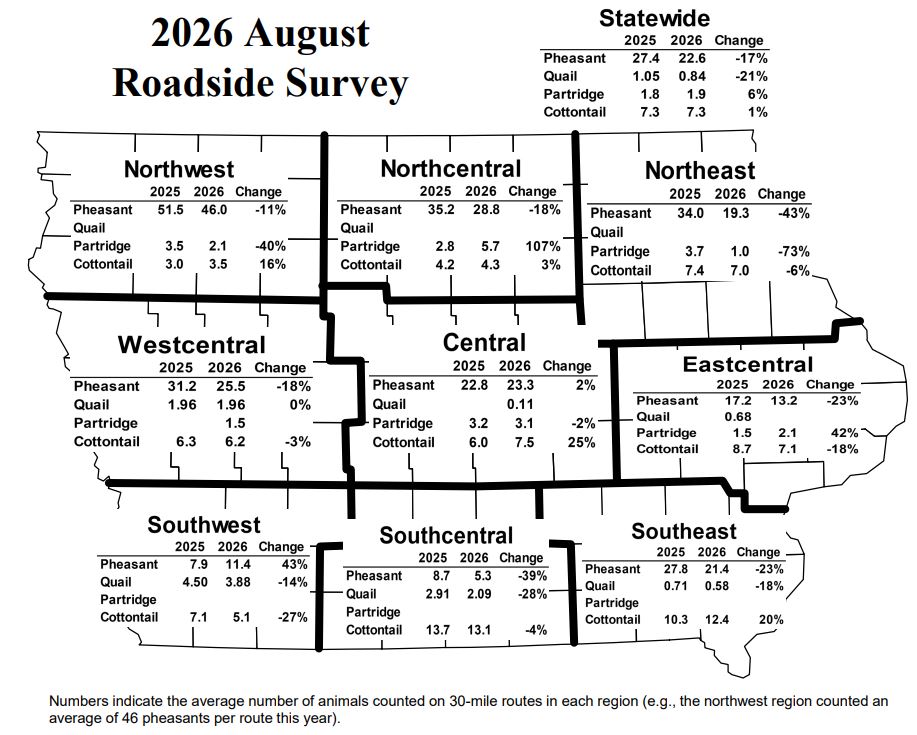
2025 brought an extraordinary rebound in Iowa's pheasant population. Despite more typical winter conditions in 2025-26, the pheasant population has held onto much of that gain — down from 28 birds per route last year to 23 pheasants per route on average this year.
But that 23 birds per route is still the second-highest statewide average in the past 11 years.
Winter Lookback
When asked what changed most between this year and last, Todd Bogenschutz, Iowa Department of Natural Resources (IDNR) upland game biologist, pointed to the winter.
"Looking at the data, this last year we returned to a more normal winter. We had about the typical average for Iowa," he says. "The statewide snowfall came in right at the 30-year average of 25 inches. Compare that to last year, when pheasant numbers were good. We had 12 inches for the entire winter."
"Based on our telemetry data," he continues, "in those mild winters, we can see upwards of 90% hen survival, losing one hen out of ten radioed birds, versus in a typical average year in Iowa, where we're probably around 60-65% hen survival and losing four out of ten birds."
He adds, "If I look at the roadside counts — the total hens in particular — that's the number that seemed to fall across the board. I think that's a reflection of returning to more normal winter weather conditions compared to a year ago."
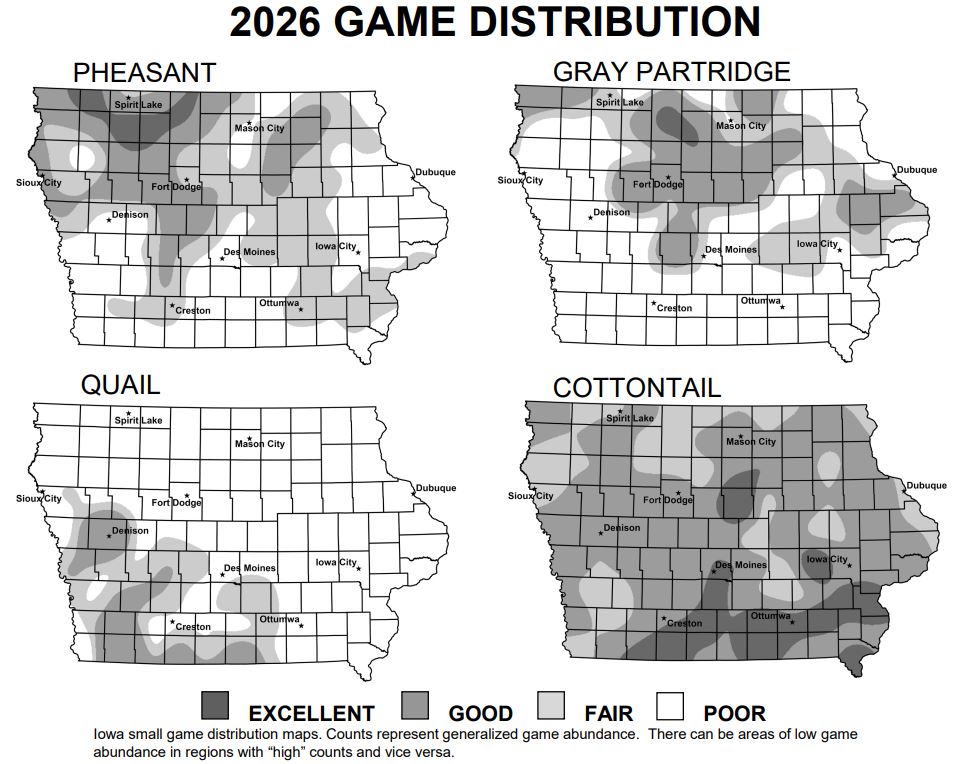
Looking at the 2026 game distribution and roadside survey maps, the differences between regions vary widely, reflecting swings in weather.
According to Bogenschutz, the eastern third of the state, specifically northeastern Iowa, had a significant impact on the statewide average. "If I took out the Northeast counts and the Southeast counts," he says, "the stats probably would have shown no statewide change."
"The Northeast had over 30 inches of snowfall," he points out. "They were the snowiest part of the state. The Southeast saw the most rainfall during the spring period. That aligns with what we saw in bird counts. In contrast, counts in the Northwest did the best, with average snowfall. They were the drier part of the state. So they had one of the smaller decreases in bird counts."
"Winter was rougher for our birds," confirms Tomas Heidenwirth, North Butler Pheasants Forever chapter president and youth chair, in northeastern Iowa. "Last year, our area got multiple snowstorms that dumped anywhere between 16 and 18 inches of snow at a time toward the end of the season. So it really spread the birds out pretty wide looking for food and shelter. A lot of the shelterbelts were blown and snowed in with heavy snow."
Contrast that statement to what Paul Daniels, Clay County Pheasants Forever chapter president in northwestern Iowa, had to say: "Overall, our region of the state had a mild winter, which resulted in some excellent adult bird survival rates. This good fortune continued into the spring and early summer, with only minimal large rain or hail events."
Nesting Season Success
That resilience also shows up in the nesting season, when hens have more than one chance to raise a brood. The clutch from a first nesting attempt is typically the largest, so weather and temperatures during the early nesting period can have a significant impact on chick survival.
Hens have the ability to continue renesting until successful, but late-season hatches can reach a point where it is simply too little, too late.
"It seems like while the summer was wet for us, particularly during July and August," says Bogenschutz. "But our peak nesting months, May and early June, were favorable. They could have been better, but they weren't bad. We had a lot of hens coming into the nesting season a year ago; this year we had fewer. Taking a little bit of a tumble coming back to average winter conditions from a super mild winter is to be expected," said Bogenschutz.
Bogenschutz went on to explain that the timing of hatching becomes particularly important late in the season. "If chicks are hatching around August 15, we had better hope for a very late winter because, even by December, those birds aren't fully developed yet. It's great that hens are persistent re-nesters, but the fact that some folks were seeing sparrow-sized chicks on August 15 in northeastern Iowa indicates the hens struggled with the first nesting attempt."
Bogenchutz's assessment is echoed by what Pheasants Forever members and local wildlife professionals have been seeing in the field. While conditions varied by region, reports from across the state point to successful nesting, with good-sized broods and young birds ranging from small chicks to nearly full-grown.
"Observations from those who are traveling the gravel roads are that they are regularly seeing a lot of good-sized broods that are able to fly," says Daniels in northwestern Iowa. "A significant amount of CRP burning took place this spring, which created lush habitat for nesting, as well as a place for the chicks to hide from predators and to feast on ample bugs."
"Throughout the summer, I observed young pheasants of all sizes on a daily basis, from small chicks to nearly full-grown birds," says Zoie Lecy, Taylor County Pheasants Forever treasurer, and Director of Taylor County Conservation Board in southwestern Iowa. "Based on these consistent sightings, I believe our pheasant population appears to be thriving."
"Certainly in northeastern Iowa, and far east-central Iowa, we've been on the wet side here this summer," says Curt Kemmerer, Northeast District DNR wildlife supervisor. "A lot of our rainfall was after we got through at least the early stages of the nesting season. So those first nests should have had better weather conditions. Across the region, my team and I have seen hens that must have had pretty good luck."
"Everybody that I've talked to here, and from what I've seen personally, we had a pretty fair hatch here," says Daryl Landsgard, Clayton County Pheasants Forever treasurer and Clayton County Conservation Board chairman. "We did have one rain event that I was worried might have hurt things. And honestly, it might have hurt things a little bit. But we've seen some nice broods, so I'm not too concerned that we're going to be much different than we were last year as far as pheasant numbers go."
"We had quite a bit of rain early in April," says Amy Buckendahl, president of the Iowa Heartland Chapter of Women on the Wing and biologist for the Iowa Army National Guard in Iowa's central region. "Because it was so early in the nesting season, the birds were able to renest. We still had plenty of moisture to provide excellent rearing habitat for that second-attempt clutch."
"We had adequate rainfall, but it wasn't crazy," says Richard Daugherty, Van Buren Pheasants Forever and Quail Forever chapter president and Van Buren County Conservation Board director, in Iowa's southeastern quadrant. "The whole year has been ideal, and we're seeing the numbers and seeing little ones. Now here lately we've gotten a little out of hand on rain, but for the bulk of the nesting part of the season, we had pretty good conditions."
Habitat and Hunting
Overall, northwestern Iowa continues to lead the state in pheasant hunting opportunities, while north-central and central Iowa remain strong. Southwestern and south-central Iowa continue to offer good opportunities, while the Northeast and Southeast saw some of the larger decreases. Local habitat and access will determine where hunters find the best numbers of birds.
As always, habitat remains at the core of the picture.
In western Iowa, Josh Schaben, Loess Hills Pheasants Forever president and Monona County Conservation Board director, has seen good upland bird numbers but is also watching CRP contracts that are set to expire over the next couple of years. "Habitat is the key to upland bird success, and with CRP contracts not matching cash rent, I'm afraid we will be losing a fair share of CRP soon," he says.
In Poweshiek County, Tylor Nelson, Pheasants Forever chapter habitat chair, is seeing landowners adding small native grass microplots along waterways and field edges to create a more connected network of habitat.
"The goal is across multiple locations," Nelson says. "These small patches of native grasses are providing habitat for birds to hop around from farm to farm. So it's becoming like a multi-cross-fence initiative. And it doesn't take somebody putting in 40 acres every other farm. It just takes good habitat along edges to provide for a population. Every little bit helps."
The biologists call it "connectivity."
IDNR's 2026 roadside survey also provides a look at Iowa's other upland birds.
Bobwhite quail declined 21% but remain at the 10-year average, with the strongest numbers in southwestern, south-central, and west-central Iowa.
Gray partridge numbers remain strongest in north-central, central, northwestern, and east-central Iowa.
Rabbits are everywhere!
"I am seeing quail and pheasants in places I'd never expected," says Schaben. "Quail numbers may be at or close to all-time highs in our area."
With another promising roadside survey report in the books for 2026, let's all hope for a nice fall, and then a mild winter where cover doesn't get blown in, food sources remain available, and birds have the shelter they need to weather the winter.
Get ready to set your sights on a favorite Iowa pastime of pheasant hunting with good dogs, family, friends and neighbors this fall. There will be more stories to tell!
Season Details
Dates
October 31 — January 10, 2027
Bag Limit
3 Roosters
Possession Limit
12 Roosters
Notes
Shooting hours for pheasant hunting are 8:00 a.m. to 4:30 p.m.
Kansas
Pheasant Hunting Forecast 2026 - Kansas
Wet Conditions Have Kansas Pheasant Habitat Booming
By Casey Sill
Prepare to push through some thick cover if you hunt pheasants in Kansas this season.
After years of drought, the last several summers have brought plentiful rainfall to Kansas. This year continued that trend, and has created some excellent habitat conditions across much of the state. This should point to a quality pheasant hunting season in 2026.
"Nowhere are we hearing that anything is down (from last season)," said Tyler Rafter, Pheasants Forever's Kansas state coordinator. "So I expect bird numbers to be either consistent with last year or higher, because we did get those ample rains throughout the summer."
Weather and Habitat Conditions
Prior to the summer conditions, Kansas also had a favorable winter. Mild weather led to good carryover of adult birds, and the spring survey results were excellent.
"Spring surveys for pheasant and quail were both really good this year after high production last year, and a mild winter that resulted in good carryover," said Jeff Prendergast, upland game bird program coordinator the Kansas Department of Wildlife and Parks. "Nesting conditions coming out of winter were very good across much of the state, since summer precipitation in 2025 was also heavy, and resulted in a lot of residual cover."
The 2026 rains didn't come immediately however, and in early spring conditions became quite dry.
"Many of the annual nesting covers were in poor shape, and dry conditions were becoming concerning for brood cover," Prendergast said. "However, staring in mid-May and through much of June we started to get heavy and frequent rainfall across much of the state."
Like with most weather events concerning upland birds, with every positive comes a potential negative. The rains left habitat in great shape, but did not come at an ideal time, according to Rafter.
"We got good vegetative growth, habitat conditions shaped up well, and insect populations boomed with the rainfalls," Rafter said. "However, with some of the heaviest rains hitting Kansas during the time broods would've been freshly hatched, there may have been some early season mortality."
Late summer brought its own challenges. Lengthy periods of high heat put pressure on young broods, particularly from hens who had to re-nest due to heavy rains.
"These weeks with extended periods with highs in the triple digits can impact chick survival," Prendergast said. "This is particularly true of younger chicks, or in areas where there was not ample insects and cover."
The sometimes dramatic shift in weather patterns throughout the summer make estimating the overall pheasant population difficult. But, all things considered, Prendergast said Kansas should be in good shape heading into fall.
"There is always a lot of uncertainty about fall bird populations, given the volatility of spring and summer," he said. "However, we are cautiously optimistic at this time – given the good spring breeding potential, initial quality nesting cover and the overall rainfall amounts."
Top Spots
Western Kansas has long been the primary pheasant ground in the state, while eastern Kansas favors the bobwhite quail. That will remain true this year, although parts of western Kansas did remain dry for a longer period of time than the rest of the state. This could lead to reduced pheasant populations in places. That said, habitat is still in great shape, and there's nothing to suggest a dramatic decrease in bird counts from 2025.
Central Kansas should also be set up well, though places around Salina saw some of the heaviest rainfall totals of the year. Chick mortality from flooding and washouts will likely be higher in that area. But locals are still seeing broods, and remain optimistic about the hunting season ahead.
Regional Reports
Central / North Central
Javier Marin, Quail Forever Farm Bill biologist II in Osborne, Kansas
It seems like the birds have had a relatively good hatch this summer, and brood-rearing conditions are good. Pheasant numbers are on the "fair" side. I still see them most days I'm in the field, just not quite as many in terms of numbers.
I have seen a fair number of young birds, primarily pheasants, but they are also a lot easier to spot than a young quail chick.
Talking with producers, they have also seen a good amount of both pheasants and quail, and I've heard from multiple different landowners that this is the most pheasants they have seen for quite some time.
Rain has been spotty in this area since the end of June, but vegetation is still doing okay, and insect numbers are high. I know with this last winter being very dry that some farmers had to leave this year's wheat unharvested and turn it into insurance; hopefully the extra grain out there will also help benefit these birds later in the year.
Cody Miller, Quail Forever Habitat Specialist in Glen Elder Kansas
With the focus of my work being in Mitchell and Jewell county, and extending into a few others, the bird population seems to have slightly grown from the previous year. During my brood routes I have viewed quail, pheasants … and turkeys, which appear to be doing really well. Upland bird cover seems to be fair, but I have found quite a few thick patches of grass that will provide ample cover this come fall.
Western
Jim Millensifer, Pheasants Forever Supporter from Oakley, Kansas
I know we had good carryover of pheasants last winter. We had lots of adult birds late into the season, all the way to the last week of January. There were no adverse winter conditions. My only concern is the moisture we got was too late. I'm hoping it's as good as last year, but I'm concerned about the crop of new birds just based on how long it took us to get rain and how dry it was before we got the moisture. Southwestern Kansas was really good last year, especially late in the season. If we are similar to where we were a year ago, which is what I'm hoping, I'll spend as much pheasant hunting time in the Southwest as here in the Northwest this season.
Eastern
John Holmes, Quail Forever Habitat Specialist in Lecompton, Kansas
We've got quality habitat supporting both pheasants and bobwhite quail. But as far as pheasants go — in the 16 years my assistant manager has worked here plus the time I have worked here, we have never seen a wild pheasant.
Russell Haynes, Quail Forever Habitat Specialist, Clay Center Kansas
I'll echo John's take for my area as well. We've got supportive habitat available across my region as well. But we seldom see a pheasant brood.
Season Details
Dates
November 14 — January 31, 2027
(Youth Season November 7 — 8)
Bag Limit
4 Roosters
Possession Limit
16 Roosters
Michigan
Pheasant Hunting Forecast 2026 - Michigan
Michigan Pheasant Hunters Should See Good Bird Numbers
By Casey Sill
Michigan pheasants have to deal with a lot more cold and snow than in many other places across the upland range.
But as well all know, pheasants are hardy birds, and the roosters of Michigan are well equipped to handle northern winters.
The last two winters in a row have seen good bird survival, and all signs indicate another good year ahead for Michigan pheasant hunters.
"Last year's hunting was a little better than the year before. The year prior was a little down from our average," said Ben Beaman, Pheasants Forever's Michigan state coordinator.
"This year I am cautiously optimistic to see maybe even a slight bump over what I saw last year for birds," he adds. "Maybe more in line with 2023, which was a little above average."
"In a state like Michigan," he adds, "where we're on the fringe of the pheasant range, it doesn't take much of a bump for me to consider it to be an above average year."
Weather and Habitat Conditions
The winter of 2025-26 was long, cold and snowy. But it lacked the biggest threat to adult pheasants — ice.
"We didn't have any major late-winter or early-spring ice storms like we've had the last few years," Beaman said. "So the snow we did have, despite sticking around for a while, was mostly manageable from a pheasant's perspective. A lot of snow drifted and got piled up in ditches in certain spots. That probably rendered some habitat inaccessible. But for the most part it wasn't anything crazy."
The snowfall did leave the state's pheasant range with plenty of moisture when spring finally did arrive. The snow melt, plus quality spring rains, put upland habitat in good shape as nesting season arrived.
"We had good, consistent precipitation throughout most of the spring," Beaman said. "So habitat is in really good shape, especially in my area down here in the southeastern corner of the state."
The wet spring meant hay and alfalfa fields in the state's core pheasant range came out later than normal, which can be another positive for broods.
"That generally bodes well for birds," Beaman said. "There's probably some nesting impact from the additional moisture, but I think they're offset by the fact that (broods) didn't get chopped up by a swather. In those years where haying is a little delayed, it's usually a positive thing."
The "Thumb" of Michigan was particularly wet this spring, according to Pheasants Forever staff accountant and avid bird hunter Tonya Sies.
"We had a lot of flooding in Michigan in March, and in April we had more flooding and a lot of severe storms," she said. "We had standing water all over the thumb area. Then in May, we started to dry out."
Top Spots
Michigan's pheasant stronghold remains consistent year to year. If you want to find birds, head to the southern third of the state.
"Southeastern and south-central Michigan are our agriculture-dominated landscapes, and that's where our best pheasant habitat is," Beaman said. "You can find some success outside of those areas as long as you're in the southern two-thirds of the lower peninsula, but it gets spottier as you go north."
However, the Thumb also holds some excellent habitat and can provide good hunting opportunities. Sies said despite the wet conditions in early spring, folks in her area are seeing plenty of birds.
"A friend of mine was turkey hunting in one of the biggest areas for pheasants in the thumb this May, and reported hearing a ton of pheasants," she said. "I'm hearing good things, and I have high hopes for this season."
Michigan has several public access programs available for anyone who's not able to hunt private land.
The state's Hunter Access Program (HAP) lands offer private lands leased to provide public access. There are numerous properties in southern Michigan, which can be found on the Department of Natural Resources website. And Michigan's Adopt A Game Area program also provides excellent places for the public to hunt roosters.
Season Details
Dates
October 10 - 31 in zone 1 (upper peninsula)
October 20- November 14 in zones 2 and 3 (lower peninsula)
December 1 - January 1 2027 in a portion of zone 3
Bag Limit
2 Roosters
Possession Limit
4 Roosters
Notes
Find maps and more specific information on pheasant zone boundaries in the complete 2026 Michigan Small Game Hunting Regulations Summary.
Minnesota
Pheasant Hunting Forecast 2026 - Minnesota
Minnesota Looking Good for a Big Pheasant Season
By Tom Carpenter
As summer wears on, the phone calls begin, and the visiting builds.
Was last winter as easy (or hard) on the birds as we thought? Did those spring rains kickstart the habitat and help the birds … or hinder nesting attempts? Those were some big rounds of storms we had in June — you think those little chicks made it through? Man, it got dry after the fourth of July — was the bug crop robust enough for feeding those little pheasants? Are you seeing birds and broods?
Minnesota pheasant hunters are a funny lot. We worry a lot. We love our birds. We hunt hard. And we invite you to come join us in a great pheasant hunting state … or just keep on stopping short in Iowa or traveling right past for the great Dakotas.
In the 2025 season, 228,337 pheasants were harvested in Minnesota. Public lands to hunt in the pheasant range are ample indeed. Need more?
This year's Minnesota Department of Natural Resources (DNR) Annual August Roadside Survey promises an even better 2026 season in North Star pheasant country.
Let's take a look at the survey results, and then take our annual tour around Minnesota's pheasant range, visiting with folks in the know.
Survey Results
Pheasant numbers in the 2026 Minnesota August Roadside Survey were up nearly 20% from 2025, when numbers were up 50% from 2024.
"Weather conditions during our surveys in 2026 were generally favorable, with temperatures, dew, wind, and sky cover all similar to their respective 10-year averages," says Steven Woodley, senior wildlife research scientist with the Minnesota DNR Farmland Wildlife Populations & Research Group. "Therefore, weather conditions were unlikely to have substantially influenced survey results."
In short, the birds were out and about, and the survey likely painted an accurate picture of what is out there for pheasants.
After a mild winter (by Minnesota standards) that our hardy birds had no trouble surviving (and one might even say thriving) through, "early (spring) moisture helped the habitat, and dryer weather followed to help the hatch and broods," says Woodley.
"In general, the warmer, drier summer helped nesting success, broods, and overall survey counts," he says, which aligns with what you will see in the field reports that follow.
Brood counts and brood sizes were good. "The number of chicks per brood (4.1) was similar to 2025 (3.9), while the number of broods per 100 hens increased from 82.0 in 2025 to 93.2 in 2026," says Woodley.
The size of young birds was meaningful too. "The median hatch date this year was June 11, roughly a week earlier than in 2025, which was June 17. This generally suggests that more first nesting attempts succeeded" this year, says Woodley.
This year's statewide pheasant index was 89.9 birds per 100 miles of roads driven, compared to 75.2 in 2024, for an increase of 20%.
Pheasant indices increased from 2025 in the West Central, Central, and South Central regions by 74%, 25% and 17%, respectively. In contrast, pheasant indices decreased in the Southeast, East Central and Southeast regions by 51%, 29%, and 15%, respectively.
What may matter more though, for pheasant hunters, are absolute numbers of birds on the landscape. The West Central (132.9 birds/100 mi), Southwest (130.1 birds/100 mi), South Central (95.8 birds/100 mi), and Central (73.9 birds/100 mi) regions had the highest 2026 indices and should provide the best pheasant hunting opportunities in the state.
Here is Minnesota's 2026 Pheasant Hunting Prospects Map, courtesy of the Minnesota DNR. You gotta like all that dark brown.
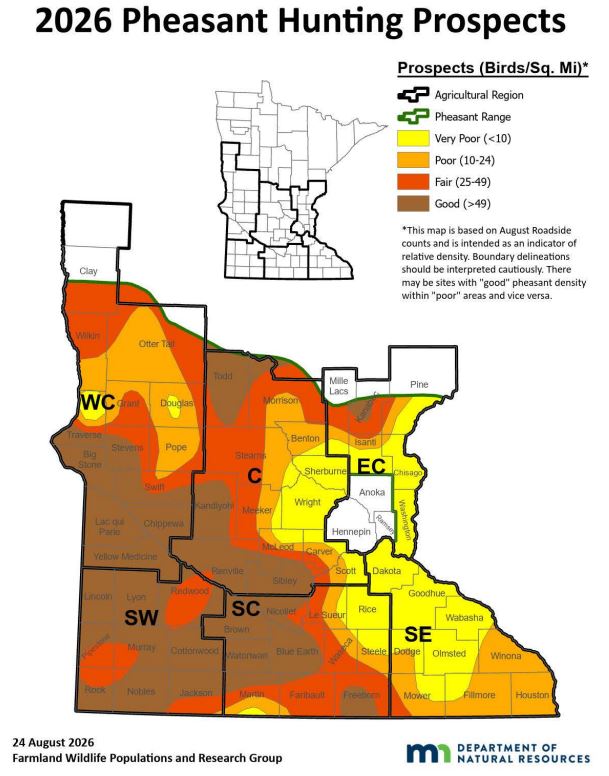
So, here we go … time for our annual tour around pheasant country to see what Pheasants Forever staff and volunteers are saying for their corner of Minnesota.
Alexandria Area
Sabin Adams, Minnesota State Coordinator for Pheasants Forever
In central Minnesota we have seen what I would call nearly perfect nesting conditions this year.
Spring and early summer received adequate rain to provide nesting cover after a mostly mild winter, all while avoiding any significant downpours that can flood out nests. Brood-rearing conditions seemed to be decent, with a good hatch of bugs mid-summer.
I suspect most hens were successful early on, with their first nesting attempt, but those that failed due to depredations, etc., should have had good nesting conditions for a second try all summer.
Take a mental picture of the prairies in 2026, because if pheasant populations are an indication of quality habitat (which they must be), then the habitat looks incredible.
We are in a moderate drought. But if that is having a negative impact on pheasants, it hasn't been realized yet by brood sightings. Even if the drought is having an impact on populations, the effect is small and will not be noticed by hunters this fall with how many birds appear to be on the landscape.
This may be the most broods that I have ever seen in a year in Minnesota. I'm seeing pheasant chicks on roadsides every time I get in the car. One day in August I spotted four broods, all older chicks ranging from 6-10 birds in each brood, while driving past one mile of WMA habitat.
DNR area managers and volunteers conducting roadside surveys are also telling me they are seeing significant increases in brood counts even over last year's good numbers.
What's my prediction for the hunt this fall? Tailgate coffee by 9:15!
Brown County Area
Tom Kraskey, Brown County Pheasants Forever
We've had two fantastic winters in a row for the birds — nothing excessive for snow or cold that the birds couldn't easily handle. And the springs have been great too. Especially this spring: no heavy rains, monsoons or cold. The moisture we did get came nice and slow.
With those good nesting conditions, some of the broods hatched early this year. I have been seeing broods since late May, and those birds already were decent sized — perhaps softball-sized by then. Of course, plenty of birds hatched on into June.
We have more broods running around than I have ever seen before. The other day I drove a 2-mile route and saw 5 broods with an average of 8 to 9 birds each.
We could use a little more rain now (late summer has been quite dry), but the grass looks good.
Bown County PF has helped permanently protect 6 parcels, with 6 more in the works, in our area. Soon we'll be at 2,000+ acres added for the county's wildlife, and for hunting.
I've got a feeling that folks are going to be amazed at bird numbers this fall.
Kandiyohi County Area
Aaron Wilson, PF Senior Farm Bill Biologist
2026 has been quite different from last year. The temperatures have been warmer. The rain was consistent, but manageable.
Nesting conditions seem to have been as close to ideal as one could ask for. The last few years have started the same way, but we ended up with cold snaps or heavy rains right at peak hatch. We didn't experience any of that this spring in the Kandiyohi County area.
From what I have been seeing, most broods appear to have been from first nesting attempts or early second attempts. Most young birds look to have hatched in June, and a few in early July. I have not seen any late July or August hatched broods, like we did last year.
Typically, in past years, I would see one or maybe two broods in a day when out doing field work. This year I've been seeing five to six broods per day. They have been in all parts of the county as well.
I haven't seen any large broods of over ten birds; most broods are in the range of three to six birds.
Our cover is looking good in this area, thanks again to those consistent and manageable rains.
With everything I have been seeing this summer, it appears it should be a very good hunting season. If that is the case, I'll probably do more exploring, out and away from my go-to spots. It's never a waste of time to venture into new areas … but this will certainly be a year to do it!
And most importantly, more birds will mean a happier bird dog.
Lac Qui Parle County Area
Gary Hauck, PF Supporter
Last winter was mild out here in Lac Qui Parle County. All the birds came through fine.
Spring was excellent for nesting: no excessive rain, no flooding in the low grassland areas that many of our birds like. Our grass was perfect in June, and is still very nice, though we can't seem to buy a rain lately.
It has all been good for the hatch, and for brood-rearing. I have been seeing broods on my daily drives and walks. Other farmers and folks that I talk to are seeing pheasants too … more than they have in a long time.
We had a good first hatch, and those roosters are already coloring up. There are some late broods too – little guys still running around. Those brood sizes are a little smaller. We are seeing more broods than last year, that's for sure, and last year saw some very good hunting.
This is the year.
Lyon County Area
Mark Peper, PF Farm Bill Biologist II
Spring and summer brought mild to warmer temperatures and few major storms, which helped birds hatch and raise broods successfully.
The presence of younger pheasants in August shows some successful second nesting attempts as well, and habitat quality is excellent where tall grass remains.
However, haying on Conservation Reserve Program land in Lyon County due to drought might affect bird locations. Some scouting might be in order before the season starts.
My observations, and conversations with landowners, tell me that this pheasant hunting season appears as good or slightly better than last year.
In addition, corn and soybeans are maturing quickly. If weather stays favorable, expect an early crop harvest. That can help hunting success early in the season.
Birds will be here in Lyon County and the surrounding area. My advice is simple: Find some pheasant habitat and start walking.
Morris / Stevens County Area
Dave Jungst, PF Supporter and Prairie Fanatic
Our birds came through last winter well. Spring weather was good for nesting, and we were seeing a lot of broods early on, in June and early July. So the hens' first nesting attempt was quite successful.
My dog and I flushed 4 groups of pheasants in one 40-acre patch of cover in late August, as just one example of what's out there. And the birds are good sized! I don't think there needed to be many second nesting attempts, given the good nesting and brood-rearing conditions early on.
We have been dry for much of the summer. But insect production was still good, providing high-protein forage for those hungry young birds. We did have a lot of humidity, which I think helped the insects, and perhaps even the habitat, which is thick and tall and looks very good.
In a conversation with our local conservation warden last fall, he mentioned that there were 300 different parcels of public land parcels within 30 miles of Morris. You might want to visit.
Nobles County Area
Scott Rall, Nobles County Pheasants Forever
I did 3 DNR roadside survey counts this year. Over the last 5 years or so, these routes have averaged 14 to 19 birds sighted per route. This year, it was a (rare) rainy day for one of the counts. But of the other 2 routes, one had 31 birds this year, and the other 61.
The weather has been great from early nesting season to now, for the birds. We have had the best reproduction I have seen in a long time. The first nesting attempts were very successful; only a nest that got robbed would have required a second attempt.
The birds I saw on my routes, and have been seeing otherwise, support that idea of first nesting attempt success. I would say 85% of the young birds I saw on my routes were 10 to 15 weeks old, which would support that. I am seeing lots of young roosters coloring up nice already … but no tails yet! That is ahead of where they usually are.
The crops needed more rain in our area, but conditions have been good for pheasants. The grass is tall and healthy everywhere here. Habitat that didn't get burned last spring is maybe 5 feet tall. Habitat we burned this spring is 7 feet tall!
Bird numbers are great. Hunting should be as good as I can remember.
Woohoo!
Pine County Area
Shayna Vendela — PF Farm Bill Biologist II
Our mild winter on the northern fringe of Minnesota's pheasant range had birds able to pick at exposed fields longer, with food availability up. But the biggest deciding factor for birds here last year was likely their good access to thermal cover, which also is good for escaping predators.
My spring no-till field checks produced sightings of multiple roadside pheasant broods. It appears the first hatch was mostly successful. Low spring rainfall might have increased that success.
As of late August, most of the young I have seen have been pretty big. I haven't seen many smaller groups of smaller birds lately that would strike me as later hatches.
Several landowners are reporting successful broods and sending in pictures of different wildlife on their properties.
We have pockets of good pheasant habitat in Pine County, and Kanabec County. Interest is up for programs like CRP and wetland restorations in my office, which is benefiting the birds.
My prediction is that the hunt will be the same or slightly better than last year. My advice would be to get your boots on the ground in WMAs that border ag fields if you're hunting up this way, and to utilize online resources like Ebird for bird sightings.
Pipestone County Area
Marty Wollin, Pipestone County Pheasants Forever
Everybody I talk to who travels around Pipestone County – chapter guys out scouting for hunting season, commuters, farmers, folks just out for a drive – is seeing a lot of birds and saying our pheasant numbers should be at a 10-year high.
We had a mild winter, and a good spring without too much rain and no flooding downpours. Those conditions contributed to a good first hatch. In fact, this year's birds are good sized, and the young roosters are already coloring up. There are a few second-attempt broods, but the first hatch really did the trick.
Predators may have been the only challenge the birds saw during nesting and brood-rearing. We could use a few more coyotes to take care of the foxes, coons, skunks and other nest raiders. But our habitat looks good, and habitat is the bottom line.
That said, there is one fly in the ointment here. With the dry late summer we have had, some CRP and grasslands have opened to emergency haying and grazing. You might want to scout out your spots. The birds were mostly big enough to escape this activity, which is good, but some habitat is being worked over. Some of that haying, and grazing when rotated and done right, will be good for the long run.
All in all, it's going to be a good pheasant hunting season in Pipestone County.
Stearns and Wright Counties Area
Eran Sandquist, Midwest Director of Conservation Delivery for Pheasants Forever
I have been seeing several broods in neighborhood. Even on my couple acres there was a brood in my driveway along my pollinator plot the other day. They scurried across the road when I came outside. The broods I have been seeing have varied in size and quantity but seem to indicate, at least anecdotally in my area, a decent hatch in June.
Carp's Final Note
Even when there are good numbers of them around, which there should be this year, wild pheasants are never pushovers. They don't just hold up their wings and give up. They will still run wild, evade our dogs … and make fools of us.
With the early hatch we seemed to have, even young roosters will be cagey. Count on it.
So, be ready to work. Hunt quiet, hunt smart.
And think about this. Our generally dry summer means cattail sloughs will be dry … and prime spots, even early on, for roosters to escape hunting pressure and find some quiet and solace.
Pheasants never make it easy.
Season Details
Dates
October 10 — January 3, 2027
Shooting Hours
9:00 a.m. to sunset
Bag Limit
2 Roosters through November 30
3 Roosters starting December 1
Possession Limit
6 Roosters through November 30
9 Roosters starting December 1
Notes
Read the full Minnesota DNR Roadside Survey Report here.
Missouri
Pheasant Hunting Forecast 2026 - Missouri
Missouri's "Bonus Birds" Weather a Wet Spring
By Ryan Sparks
Missouri's pheasant outlook is similar to last year, with similar numbers in similar locations.
Statewide survey numbers were essentially unchanged, though the Northeast showed a modest increase.
Missouri isn't a primary pheasant destination, and hunters typically consider roosters more of a "bonus bird" while pursuing bobwhite quail. Still, those keen on chasing pheasants can find opportunities in the far northern counties, where pockets of habitat support huntable pheasant populations.
For hunters willing to put in the work, scout, and knock on doors, the chance at a "Show-Me State" rooster adds some exciting variety to Missouri's upland experience.
Habitat Conditions and Pheasant Numbers
Where there is habitat, Missouri pheasant numbers have been slightly increasing for the past two years, but hunters should keep their expectations in check.
In 2026, Missouri's pheasant population looks to be remaining stable to slightly up in the northern counties, where limited pockets of grassland habitat intersect with agriculture.
"Pheasant numbers were just about the same this year as last year, which are not great," says Beth Emmerich, Quail and Upland Game Biologist with the Missouri Department of Conservation. "We recorded 0.23 birds per route compared to 0.25 per route in 2025."
There is, however, a brighter spot in northeastern Missouri. Counts there increased to 0.38 pheasants per route compared to 0.29 in 2025. That makes Northeast Missouri the place to be in 2026 for those determined to bag a long-tailed Missouri rooster.
That assessment generally matches reports from Pheasants Forever and Quail Forever staff across the state.
"The further north you go, the better," says Andrew White, PF & QF's Missouri State Coordinator. White describes this year's pheasant population as very similar to 2025 despite significant flooding events during the spring and summer. "Where we have quality habitat, I think pheasants were able to hang on and successfully nest," White says.
Ayden Carey, PF & QF's Northern Missouri Regional Representative, is simultaneously optimistic and cautious.
Carey says some of the properties he hunts produced some of the best pheasant numbers he had ever seen last year, and another mild winter should have provided good carryover. However, he heard fewer roosters crowing during spring turkey season and believes heavy spring and early-summer rainfall may have reduced production in portions of northern Missouri.
Heavy rainfall is one of Missouri's biggest variables heading into fall. Significant flooding occurred at different times across Missouri, and some early nesting attempts were likely lost. At the same time, that moisture produced excellent brood-rearing habitat, which in turn becomes excellent habitat to hunt this fall.
"I do believe some nesting attempts were thwarted by this, but we have been hearing about large-sized broods spotted as late as the beginning of August," White says. "I think brood-rearing conditions greatly benefited from that precipitation, with prolific blooming of forbs that attracted more insects."
Carey reports a similar habitat picture. Where CRP, managed public lands and private-land habitat remain, conditions are good. He also notes that more Missouri landowners are using prescribed fire to improve habitat, which is making a big difference.
Carey's biggest concern this year is the heavy spring storms that hit parts of North-Central and Northeast Missouri. Still, habitat may be one of the most encouraging parts of Missouri's 2026 pheasant outlook.
"Our weather conditions over winter were mild overall, and spring came on fairly wet in most places," Emmerich says. "What people need to look for is habitat, which is limited for pheasants in Missouri."
White puts it more simply: "Current heat aside, I do not recall ever seeing Missouri this green in late August. Where there is habitat, it looks great!"
It is important to note that beyond the beneficial weather, conservation efforts are making a big difference in Missouri for both quail and pheasants.
Nesting and brooding cover has increased throughout the state thanks to the Conservation Reserve Program (CRP), National Resource Conservation Service (NRCS) and Missouri Department of Conservation (MDC) programs. The last few years these programs, along with PF & QF efforts have funded over a million dollars of projects designed to improve quail and pheasant habitat.
Healthy habitat means healthy bird numbers. Thanks to conservation projects, Missouri pheasant numbers are slightly up, and quail are doing well.
Still, Missouri pheasants ultimately remain what they have been for most hunters in recent years – a bonus bird.
Access
Hunters should check the Missouri Department of Conservation's interactive map showing Missouri Recreational Access Program sites (MRAP), where private land is leased for hunter access.
Hunters also shouldn't overlook Missouri's Quail Restoration Landscapes (QRL), where habitat work on both public and private land has led to quail densities of up to a bird per acre. Pheasant and quail habitat often overlaps, and you will often find both birds in QRLs.
Pheasant habitat in Missouri is limited and highly localized. Hunters should look for larger blocks of thick cover, CRP, and other grassland cover adjoining crop fields. White recommends working north, and Carey echoes his advice.
"If I was going out specifically to hunt pheasants, I wouldn't be south of Highway 36," Carey says. "Anywhere north of Highway 36 will get you started. Quail numbers are looking pretty strong this year, so I would plan to hunt quail and hope you find a bonus rooster or two."
Northwest Missouri may be worth a closer look this season. Carey says his chapter in St. Joseph is hearing about strong quail numbers, and pheasants showing up in places where they haven't been seen in years. That part of the state also missed some of the severe weather that hit areas farther east.
Hunters should also consider knocking on doors. With many Missouri hunters focused on deer, Carey says landowners are more receptive to bird hunters seeking permission, especially after the rifle deer season ends.
Carey also notes that a couple of new properties were acquired in Harrison County through PF & QF's Build a Wildlife Area® (BAWA) Program last year. The properties hold quail and may provide a chance to encounter a rooster in a new public hunting opportunity that hunters may not be aware of yet.
Missouri Pheasant Hunting Tips
Missouri pheasants are scattered and localized, so hunters should approach the season differently than they might in a traditional pheasant state. Finding the right habitat is more important than simply covering random public hunting areas.
Follow the Birds
White says the single biggest key is paying attention to where birds are encountered – studying the surrounding habitat and then concentrating on similar cover elsewhere. In a state with limited pheasant habitat, one rooster sighting can provide useful information about where birds are holding.
Stay North
The best pheasant hunting is in Missouri's northern counties. Stay north of Highway 36 and you are in the right area to begin your search.
Hunt Quail, Hope for a Rooster
Missouri's pheasants remain a bonus bird. With Carey reporting particularly encouraging quail numbers in northern Missouri, a mixed-bag strategy may be the most productive way to approach the state.
Look for Grass and Ag
Emmerich recommends focusing on thicker stands of grass interspersed with agricultural land. CRP, pasture ground, field edges, and similar cover near crops, offer the basic ingredients pheasants need.
Don't Give Up
"Don't listen to people that tell you that there aren't any pheasants left in the state," Carey says. Missouri roosters are difficult to find, but hunters willing to scout, walk, and search out the right habitat, can still find wild birds.
Knock on Doors
Private-land permission can open additional hunting options, particularly after rifle deer season ends.
Season Details
Dates
November 1 – January 15, 2027
(Youth Season October 24-25)
Bag Limit
2 Roosters
Possession Limit
4 Roosters
Note
Bobwhite quail season dates in Missouri coincide with pheasant season. Quail bag limit is 8 birds daily with 16 in possession.
Montana
Pheasant Hunting Forecast 2026 - Montana
Dry Conditions Will Produce Spotty Pheasant Hunting in Montana
By Jack Hutson
This report begins with the following news for traveling hunters.
Montana has set a special ten-day early start regulation for Montana resident pheasant hunters. Resident pheasant season begins on October 10. The season for nonresidents begins October 20. Montana is not the first state to apply such a regulation.
The October 20 rule for nonresidents applies to public lands of any description, and to private properties enrolled in Block Management and similar access programs. Nonresidents can hunt private land, with permission, starting October 10.
Now, on to the birds.
The winter of 2025/26 was kind to our northern tier pheasant states, and the likelihood of excellent carryover had everyone primed for spring. But key nesting weeks in June were battered by days of rain across the northern Montana plains. Then came the dry conditions. How did the birds fare? I asked experts from Montana's three major pheasant producing regions to find out.
Region 4 — North-Central Montana
"Due to above average temperatures last winter, the birds on the landscape carried over well," says Montana Fish, Wildlife & Parks (MTFWP) Game Bird Specialist, Matt Strauch. "Spring surveys showed pheasant crow counts above last year's counts, especially in places with good habitat."
"There was very little precipitation into early spring," Strauch says. "Then, in mid-June, much of the region experienced multiple large weather events. With these events came large amounts of precipitation and cooler temperatures."
But the news wasn't all bad. "The moisture we received from these storms had kept much of the region looking green well into July," Strauch says. "Habitat conditions are looking good for the first time in several years."
In general, large hail-producing storms were isolated and overall had minimal impacts on brood survival. There remains concern that those cooler wet conditions in June may have affected brood survival. Strauch says that actual brood sightings have been limited, but there is evidence that suggests a later hatch happened.
"This has been a difficult year to put together an outlook. Habitat conditions have me optimistic that numbers of pheasants will be up from 2025. Meanwhile, Hungarian (gray) partridge fared well last season in most of Region 4, and this year looks to be similar," concludes Strauch.
Region 6 — Northeastern Montana
In Region 6, MTFWP Wildlife Manager Scott Thompson reports: "We had a mild winter across the region with good overwinter survival, and an early spring. It was dryer than normal this spring, but with good residual cover. June rains resulted in good habitat with at least average nesting success and brood rearing conditions. We did have some heavy rains scattered across the region, but the field biologists have not seen evidence of significant brood failure."
PF Senior Coordinating Wildlife Biologist Loren Ruport notes that birds are still recovering from several years of drought across eastern Montana. He did relay some concern about the effect of June precipitation on pheasant young.
Returning from a recent field survey in central Region 6, MTFWP Upland Game Bird Habitat Specialist Mitch Carpenter reports: "Brood sizes were smaller than usual, with an average brood size of 2.3 chicks per brood, but I saw many more broods than usual. All chicks were nearly full-grown and able to fly."
These observations reflect both good winter survival conditions for hens, and the poor early nesting conditions that other folks suspect. Regional MTFWP professionals note that, in 2025, hunters on the western end of the region reported better upland bird numbers than in recent years, while hunters on the eastern end of the region reported fewer birds. This can explain the difference in reports.
Carpenter puts his observations into perspective: "Since MTFWP started surveying this route in 2018, the 23 chicks I counted are the most that has been surveyed."
"Based on the number of grasshoppers plastered on my windshield," he adds, "there are plenty of grasshoppers. I think the chicks have plenty of food."
The U.S. Drought Monitor shows the region hovering between Abnormally Dry to Moderately Dry status; better conditions than in recent years past.
"It has been a nice summer," Thomas says, "better than the last 4 or 5 years, with average moisture conditions across most of the region."
"A dry August could have an effect on late broods where moisture is scarce," he cautions.
"Vegetation is starting to dry out but riparian areas remain lush. If similar nesting/brooding cover conditions existed regionwide, I am optimistic that the whole region has had similar nesting success," Carpenter predicts.
Ruport's report was less optimistic: "Spring rains likely caused limited early nesting success and secondary nesting events are generally scattered and minimal. I expect below average grouse and pheasant numbers this year."
Region 7 — Southeastern Montana
"Winter in southeastern Montana was warm and dry, and large dust storms were very prevalent," says Justin Hughes, Region 7 game bird specialist for MTFWP.
Hughes' weather woes continue: "We then transitioned to a cool/wet start to the early summer months, which overlap with the nesting season. While this weather pattern brought drought relief to many areas (much of the region received above normal amounts of rain in June), there will surely be many areas where nesting attempts were negatively impacted."
It seems to be a case of all or none in Region 7. According to Hughes, the region hasn't received blanket coverage precipitation. In most cases, the weather (wind, drought, rain, late frosts, hail) was super intense in one area while minimally impacting others. That's Montana for you.
The region quickly transitioned into various stages of drought. The U.S. Drought Monitor regards more than half of Region 7 in Severe Drought status.
Hughes says, "July was very dry and hot, with many days over 100 degrees and top temperatures in the region reaching 115 degrees. Poor weather conditions, from nesting through brood season, has resulted in less-than-ideal reproduction across the rangeland."
When you ask about pheasants, the answer you get is, "It depends."
Hughes reports: "In the dryland crop and native rangeland habitats, hunters can expect to see a variety of habitat conditions and pheasant numbers that are as equally as variable."
"Of course," he continues, "more stable pheasant numbers can be found in the main river drainages across the region. These are places where croplands are irrigated and there are more consistent habitat conditions from year to year."
Recent brood sightings have been all over the board, reflecting the local weather patterns experienced during nesting. While it appears some of the early nesting birds were able to successfully hatch out average sized broods, it seems that broods that hatched mid to late nesting season had a wide range of variability.
Due to the harsh drought conditions in southeastern Montana, many grain fields were hayed in the month of July instead of being harvested with a combine at full maturity. This could potentially have an effect on hens that attempted to re-nest after losing a clutch in the moisture events of late May and June. The loss of cover on these cropland acres can also affect available brood-rearing habitat, which is critical, especially on a year like this where we experienced so much dry and hot weather in July.
Final Notes
Early season, wildfires are always a concern. Forego campfires, and keep vehicles on gravel.
To maintain the amazing access Montana offers, keep landowners in mind. Leave gates as you find them and do not block anywhere equipment might need to get through.
"It also goes a long way to stop and chat with farmers and ranchers in cafes or on backroads," Carpenter suggests. "Even if you aren't looking to gain access to hunt their land, they know the ins and outs of the area better than anyone." And who knows. You just might get a go-ahead to hunt. Montanans are great folks.
Season Details
Dates
Residents: October 10 — January 1, 2027
Nonresidents: October 20 — January 1, 2027
Youth Season: September 19 — 20
Bag Limit
3 Roosters
Possession Limit
9 Roosters / Regular Season
6 Roosters / Youth Season
Note
Nonresidents are restricted from hunting on public lands, and on private lands enrolled in an access program, until October 20. Nonresidents may hunt un-enrolled private lands, with permission, during the 10-day restriction.
Nebraska
Pheasant Hunting Forecast 2026 - Nebraska
Strong Pheasant Surveys in a Drought-Stricken Nebraska
By Ryan Sparks
Nebraska pheasant hunters have plenty to be encouraged about heading into the state's historic 100th pheasant season.
Both spring and summer Rural Mail Carrier Surveys (RMCS) increased statewide from 2025, with some of the strongest numbers showing up in the Southwest, Panhandle and Northeast.
However, the story on the ground is more complicated. Severe drought has reduced habitat in western Nebraska, especially the Panhandle, while timely summer moisture has kept habitat in better shape across much of the southern and eastern parts of the state.
Habitat Conditions
Many regions of Nebraska entered 2026 bone dry. But generally, habitat slowly improved as the growing season progressed.
Moisture toward the end of 2025 produced good residual nesting cover, and a dry start to the 2026 pheasant nesting and brooding period may have helped nests avoid losses from "gully-washer" rains and extended periods of cold and wet conditions.
Summer rains then brought relief to southern and eastern Nebraska, helping maintain brood cover and insect production. However, those rains were spotty in places, with some areas of Southeast Nebraska experiencing rainfall totals below the 30-year average every month of the year so far.
"We had decent rain during the growing season, which provided good nesting cover," says Bryan O'Connor, upland game program manager with the Nebraska Game and Parks Commission. "We were on the drier side through most of the pheasant nesting and early brood season, so nests should have been successful."
Extreme hail, heavy rainfall and other severe weather may have impacted bird numbers in certain areas, but O'Connor says there were no weather events widespread enough to change the statewide outlook. Reports from the field have included more brood sightings and good-sized broods in several districts.
The biggest habitat concern is drought. Conditions deteriorate moving west and north, with the Panhandle facing the most serious problems.
Severe drought has reduced grass height and density, and emergency haying and grazing may further reduce cover in some CRP fields and on pasture ground.
The Sandhills and northern portions of western Nebraska are also dry, though the effect is likely to be most obvious in the amount of huntable cover rather than what spring surveys suggested.
"The quail range is looking good. Moisture since June has helped improve dry conditions across most of the range," O'Connor says. "Overall, the Panhandle is pretty dry and conditions are poor for pheasants there."
PF Coordinating Wildlife Biologist Ben Wheeler agrees that drought remains the biggest concern in the Panhandle. "The persistent dry conditions have almost certainly impacted nesting cover and brood survival for pheasants in a typically strong part of the state," he says.
Wheeler also mentioned that drought can create some brood-rearing benefits by checking thick grasses and opening bare ground for young birds to travel, while encouraging annual weeds and insects. Still, in the Panhandle, the lack of cover is likely to outweigh those benefits this fall.
Conditions are different farther east. PF Senior Farm Bill Biologist John McClinton says he is seeing some of the best habitat he has seen during his time as a biologist in Southeast Nebraska. After prolonged drought left more bare soil, returning moisture produced an explosion of flowering plants and insect diversity, creating quality brood-rearing conditions.
For the most up to date drought conditions, consult the U.S Drought Monitor.
Pheasant Numbers
Nebraska's 2026 survey numbers offer a much clearer reason for optimism than last year's mixed spring and summer results.
Statewide pheasant counts increased 11% from 2025 during the April RMCS, with increases in five of six pheasant management regions. July counts were even stronger, increasing 36% statewide from 2025, with increases in all but one management zone.
Statewide April and July indices both exceeded the 5- and 10-year averages, and sat only slightly below the 20-year average. That suggests Nebraska is entering fall with a pheasant population that is generally in good shape, even if habitat conditions vary significantly across the state.
"Statewide, pheasant season should be average," is how O'Connor characterizes Cornhusker pheasants heading into the fall, while pointing hunters toward the Southwest, South-Central and Northeast for the best bird numbers.
The Southwest ranks first in the state for overall pheasant abundance. July counts there increased 17% from 2025 and were 28% above the five-year average (although still 32% below the 20-year average). Hitchcock, Red Willow and Furnas counties remain top choices.
The Panhandle ranks second, with July counts up 35% from 2025, but severe drought could make the survey strength misleading from a hunting standpoint. Cheyenne, Box Butte and Morrill counties lead that region.
Wheeler agrees that the Southwest should be a top destination. "The southwestern part of the state will host some of our best opportunities to put a bird dog on a birdy scent trail," he says.
The Northeast may be the most intriguing region in Nebraska this fall. July counts were 35% higher than 2025, 77% above the five-year average and 35% above the 20-year average. Antelope, Cedar, Dixon, and Knox counties are among the top prospects, though pheasant habitat and public access remain localized. "I think certain areas of Nebraska will be pretty good this year, but those same areas can also be tough due to the limited amount of public access," O'Connor says.
Elsewhere, the Sandhills increased 39% from 2025 in July and the Southeast increased 18%. The Central region was the lone area to decline, falling 21% from 2025 in the July survey, though it remained 21% above the five-year average.
Those Southeast survey gains also line up with observations from the field. McClinton says he has seen more pheasants this spring and summer and thinks most hunters don't realize how many pheasants are around in Southeast Nebraska, even though the Southeast remains well below the state's more well-known pheasant hunting areas.
Justin Carmona, QF's Nebraska Bobwhite Quail Habitat Coordinator, has also encountered pheasants while walking CRP and EQIP sites in the Southeast. While he cautions that pheasant numbers there remain low, his observations suggest they may be trending upward.
For hunters trying to turn the survey data into a travel plan, the key distinction is between bird abundance and huntable cover. The Panhandle produced strong counts but may disappoint because of drought, while the Southwest and Northeast combine encouraging bird numbers with a better chance of finding habitat that hasn't been scorched by drought, although access can be more difficult. The Southeast has a few more pheasants than in recent years, but accessing them will mean knocking on doors and asking permission.
Access
Nebraska has more than 1.3 million acres of public and privately owned land accessible for public hunting. For pheasants, public opportunities are highest in southwestern Nebraska and portions of the Panhandle, much of it on private land enrolled in the Open Fields and Waters Program.
In the Southwest, biologists typically add more than 30,000 acres of tall wheat and milo stubble and associated unfarmed pockets to the Open Fields and Waters program each fall. Those tracts will appear in the 2026-27 Stubble Guide.
In the Panhandle, hunters should look for clusters of CRP and tall wheat stubble enrolled in Open Fields and Waters in Cheyenne, Deuel, Box Butte and Sheridan counties.
In the Northeast, CRP enrolled in Open Fields and Waters in Antelope, Knox, Cedar, Dixon and Dakota counties can provide some of the region's better public pheasant hunting.
The Nebraska Public Access Atlas is one of the best resources available for Nebraska bird hunters. Drought and emergency haying or grazing have impacted many tracts, including some Open Fields and Waters properties. You aren't going to know what the conditions on the ground are without some prior scouting.
Another program expanding access is the Nebraska Community Access Partnership (NCAP), Nebraska's implementation of PF & QF's Public Access to Habitat (PATH) initiative. The program works with private landowners to open quality wildlife habitat to public hunting, adding new opportunities in some of Nebraska's best upland country. Wheeler specifically points hunters toward NCAP properties around Ogallala, which puts hunters in the heart of southwestern Nebraska's pheasant range.
Hunting Tips
Scout for Habitat, Not Survey Numbers
The Panhandle is the clearest example of why preseason scouting matters in 2026. Bird surveys are encouraging, but drought has dramatically reduced habitat quality in places. A property that looks promising on a map may be short, thin, hayed or grazed when you arrive.
Give the Northeast a Look
Northeastern Nebraska is one of the season's more interesting options. Survey indices are strong compared with both last year and long-term averages, but habitat and public access are patchy. Focus on finding habitat near the South Dakota border and be prepared to move between tracts.
Target Stubble and Adjacent Cover
Tall wheat and milo stubble remain a Nebraska bird hunting staple, particularly in the Southwest and Panhandle. Look for birds in both stubble and any adjacent cover. Stubble tends to be better first thing in the morning, while heavy cover adjacent to cover is perfect loafing and overnight cover for pheasants.
Watch the Weather
O'Connor identifies weather as the single factor most likely to determine hunter success. Hot, dry conditions made hunting difficult last year. Cooler days with favorable scenting conditions can make a major difference for dogs and hunters alike.
Stay Mobile
Nebraska's habitat conditions vary sharply from region to region, and sometimes from one tract to the next. If you find drought-induced conditions, or emergency haying and grazing, keep moving and searching rather than forcing a familiar location that has worked for you in the past.
Check the Husker Football Schedule
Local hunters thin when the Huskers kick off, leaving more ground for less-football-obsessed hunters.
A Milestone Season
The 2026-27 season marks Nebraska's 100th pheasant hunt – a fitting year to explore a new part of the state or revisit your favorite Nebraska hunting location.
Season Details
Dates
October 31 – January 31, 2027
Youth Season October 24–25
Bag Limit
3 Roosters
Possession Limit
12 Roosters
Notes
Learn more about upland hunting in Nebraska.
North Dakota
Pheasant Hunting Forecast 2026 - North Dakota
North Dakota Pheasant Numbers Up
By Tori J. McCormick
This is Lynn Glock's sleepless season.
Every year before the pheasant opener, the 68-year-old president of the Sakakawea chapter of Pheasants Forever turns into an insomniac.
"It's that time of year again … where the anticipation starts to build and I have a hard time sleeping. Heck, the night before the opener I don't sleep at all," said Glock, who lives 12 miles west of Garrison and hunts regularly behind two wirehaired pointing Griffons, five-year old Freya and 15-month-old Teddy.
"I sometimes find myself daydreaming about one of my dogs going on point — you know, that hard point when they are locked up like a statue and you know for certain a bird — maybe a rooster, maybe a hen — is going to flush."
"I just can't wait to get going."
The good news for Glock and other diehards like him is that North Dakota pheasant numbers are modestly improved from last year, according to results from the North Dakota Game and Fish Department's annual late-summer roadside pheasant brood count survey.
Statewide pheasant numbers were up 9% percent from last year, which is 55% above the North Dakota's 10-year average (51.1 birds per 100 miles).
Jesse Kolar, upland game management supervisor for the North Dakota Game and Fish, said the state's highest pheasant densities are located in roughly two geographic areas: the Southwest, followed by the Northwest.
"The Northeast and Southeast were significantly lower," Kolar said, adding that pheasant densities are generally lower in the eastern part of the state.
"Overall, I think we are going to have a season that's roughly the same as last year, maybe even a little better," he predicted.
Last year, the state's pheasant harvest was down 3% compared to 2024, with 53,008 hunters shooting 344,975 roosters. North Dakota's top five counties based on harvest were Divide, Hettinger, Williams, Stark and McLean — counties that are likely to produce plenty of birds this year, too, state officials say.
Inside the Numbers
According to Kolar, total pheasants observed (79 per 100 miles) on this year's survey is 8% higher than 2025. However, the average brood size (5.4 per 100 miles) is slightly down from last year (5.6 broods).
The final summary is based on 292 survey runs conducted along 100 brood routes across North Dakota. The routes are run a minimum of two times (three times is the goal) by roughly 85 state observers, most of whom are North Dakota Game and Fish staff.
The exhaustive survey, which is run annually from July 20 to August 31, is broken down into four regions. "Biologists first ran brood routes in the 1950s, but the methods we use were cemented in the 1960s," said Kolar. "So our data goes back to 1962."
In the Northwest, 11 broods and 85 pheasants per 100 miles were counted, which is up from 10 broods and 80 pheasants in 2025. Average brood size (4.7 chicks) was virtually the same as last year (4.4).
"Northwestern North Dakota continues to produce good pheasant numbers, although many hunters have caught on to this trend the last few years and hunting pressure has followed," said RJ Gross, upland gamebird biologist for North Dakota Game and Fish.
In the Southeast, 9 broods and 64 pheasants were counted per 100 miles, which is down from 9 broods and 72 pheasants in 2025. Average brood size was 5.0 chicks, which is the same as last year.
In the Northeast, 5 broods and 43 pheasants were counted per 100 miles, which is up from 3 chicks and 22 pheasants in 2025. Average brood size was 6.0 chicks, up from 4.8 in 2025.
In the Southwest, 13 broods and 112 pheasants per 100 miles were tabulated, which is down from 14 broods and 115 pheasants in 2025. Average brood size (5.7 chicks) was down from 2025 (6.1).
"Habitat conditions in the Southwest were very good for nesting. The pheasant population has rebounded to about 80% of what it was prior to the 2017 drought," said Gross.
How We Got Here
The modest uptick in pheasant numbers statewide is largely a function of weather, Kolar said. Three consecutive mild winters contributed to "high overall winter survival" of adult pheasants going into the spring nesting season. "Nesting hens were in good body condition," he said, adding spring crowing counts were strong. "We had very little snow last winter. The table was set, if you will."
Last year, Kolar said, wet and cold weather during the spring/early summer nesting season hurt reproduction, with many hens having to attempt a second nest after the first one failed. "Since this year has been hot and dry most of the summer, we can suspect that incubation was more successful," he said.
Kolar said the likely reason North Dakota doesn't appear to have drastically improved pheasant numbers from 2025 is the overall dry grassland conditions. "Summer drought conditions led to less forb production and fewer insects, like ants, beetles, smaller pollinators, and things chicks eat before they're big enough to chase grasshoppers," he said. "Hens likely moved their broods further in search of cover or greener vegetation, and longer movements are harder on young broods."
In addition, Kolar said hot, dry conditions during the survey could have impacted how many chicks were observed. "We just didn't have the dew for most of the survey," Kolar said, adding that pheasants will move to gravel roads to dry off their feathers when grasslands are wet.
It is possible, Kolar said, that are more broods on the landscape than were counted during the survey: "That's possible, but we'll have to wait and see."
Field Reports
Emily Spolyar, North Dakota state coordinator for Pheasants Forever, said she's starting to see broods show up on the landscape.
"What I'm seeing right now is a mixed bag," she said. "I've seen a few hens here and there with two to three chicks and others with more. Overall, most broods have five or six chicks."
"I think we're sitting on a good season, similar to last year," she added. "We had another mild winter and a good carryover population of birds going into the nesting season. I'm pretty optimistic."
Grassland conditions are also a mixed bag. "The cover I'm seeing right now is thick but mostly dry," said Glock. "It helped that we had decent soil moisture in the spring. Then we got super dry … and recently some areas have had decent rainfall, which should help. But we could use some additional rain, that's for sure."
Meanwhile, Kolar said private ground will likely have less cover than last year. "In North Dakota, 31 of 53 counties are approved for emergency haying of CRP," he said of the Conservation Reserve Program. "This will reduce the huntable cover for the upcoming fall."
In general, Kolar said hunters should be mindful of wildfire risk and refrain from driving on trails with grass as much as possible. "Hunters have to be careful," he said. "Avoid parking in tall vegetation."
Hunting Opportunities
For uplanders traveling to North Dakota to hunt pheasants, Spolyar said the state offers a number of public options from which to choose.
"I do most of my hunting on public land," she said. "We're blessed to have so much."
For the upcoming season, North Dakota's popular Private Land Open To Sportsmen (PLOTS) program has 925,000 acres enrolled.
There are 200-plus state Wildlife Management Areas (WMAs) across the state. Unless specified otherwise, WMAs are open to hunting, trapping and fishing.
Spolyar said she is particularly fond of hunting the state's Waterfowl Production Areas (WPAs), which total more than 300,000 acres and are managed by the U.S Fish and Wildlife Service.
"WPAs are open to public hunting and have excellent grassland cover for hunting earlier in the year as well as wetlands, the kind of heavy cover that holds a lot of birds later in the year," she said.
Other Opportunities
While there are more pheasants in North Dakota and hunters who chase them, state officials are reminding uplander hunters that sharp-tailed grouse and gray partridge can provide great action too.
According to the North Dakota Game and Fish roadside survey, sharptails were up 16% statewide (9.7 birds per 100 miles), but remain 31% below their long-term average. The survey results showed 1.1 broods per 100 miles and an average brood size of five chicks.
Gray partridge were down 17% statewide (13 partridge per 100 miles). Survey observers recorded 1.2 broods per 100 miles, with eight chicks per brood.
"Sharp-tailed grouse, unfortunately, experienced yet another year of poor production, this time due primarily to extremely hot, dry stretches this summer," said Kolar. "One perk this year is a slight increase in relative abundance from good overwinter survival."
Last year's sharp-tailed grouse harvest was down 24% compared to 2024, with 18,241 hunters harvesting 55,539 grouse. By comparison, in 2024, 21,660 hunters harvested 73,010 grouse.
Last year's gray partridge harvest dropped 25% compared to 2024, with 18,343 hunters harvesting 50,455 Huns. In 2024, 21,887 hunters harvested 67,465 Huns.
Season Details
Dates
October 10 — January 3, 2027
Bag Limit
3 Roosters
Possession Limit
12 Roosters
Notes
Nonresident Small Game License: Must choose between one 14-consecutive-day or two 7-consectutive-day license periods. May purchase more than one license per year.
Nonresidents cannot hunt state WMAs, or PLOTS lands, during the pheasant season's first 7 days.
Ohio
Pheasant Hunting Forecast 2026 - Ohio
Ohio Pheasants Hold Steady After a Hard Winter
By Brian Rhodes
Wild pheasants hold on in a few corners of Ohio. Hunters willing to work those corners should find a season much like last year's.
Conditions and Counts
A major winter storm buried most of Ohio in late January under 6 to 18 inches of snow and ice, and the deep freeze behind it kept temperatures and wind chills near or below zero for more than a week. The following week warmed only into the teens and twenties, and barely touched the snow and ice.
"It was a brutal stretch that had a lot of wildlife folks very worried," says Cody Grasser, Ohio state coordinator for Pheasants Forever and Quail Forever.
Pheasants came through better than the weather suggested they might, says Joseph Lautenbach, wildlife biologist for the Ohio Department of Natural Resources (ODNR).
Ohio's spring crow count showed no change in population indices from a year ago. And summer reports point to average breeding productivity, the real indicator of hunting season opportunity.
"I would expect this hunting season to be similar to last year," Lautenbach says.
Spring weather cooperated, and word from field staff and public land managers has been good since. Grasser's crew turned up birds at a summer field training, and he expects pheasant numbers comparable to last fall.
Top Spots
"The pheasant strongholds of Ohio can be found in the Scioto River watershed, as well as a pocket of far northwest Ohio," Grasser says. Public wildlife areas of every size hold birds, he says, along with private ground in good grassland cover, often thanks to the Conservation Reserve Program (CRP) and Conservation Reserve Enhancement Program (CREP).
In south-central Ohio, Deer Creek Wildlife Area and the smaller areas around it, in Madison, Pickaway, Ross and Fayette counties, are worth a day.
"Deer Creek is managed with crops and grassland interspersed throughout the area, creating excellent pheasant habitat," Lautenbach says. Many private tracts nearby are enrolled in the Scioto River CREP, and can be just as productive. Big Island Wildlife Area in Marion County offers large grassland blocks where birds turn up readily, and surrounding landowners enrolled in CRP add more ground worth asking about.
Farther northwest, Lake La Su An Wildlife Area in Williams County holds a robust pheasant population across cropland and grassland stitched with forest and wetland. CRP fields in Williams, Defiance and Fulton counties produce too.
"Don't be afraid to seek permission on private lands with suitable cover within the pheasant range," Lautenbach says. Get that permission in writing. The Ohio Landowner/Hunter Access Partnership page on the ODNR website lists enrolled properties and program rules.
Insider Tip
Persistence pays off. "Ohio's pheasants are smart, and in many cases you will not be the first upland hunter they encounter this season, meaning they are well-practiced at evading hunters, so oftentimes the best strategy is to stick with it," Grasser says.
Sounds like pheasant hunting anywhere.
Season Details
Dates
November 6 — January 10, 2027
Hunting Hours
Sunrise to sunset
Bag Limit (Same as Possession Limit)
2 Roosters
Oklahoma
Pheasant Hunting Forecast 2026 - Oklahoma
Mixed Feelings and Conditions for Oklahoma Rooster Hunters this Year
By Mikayla Peper
While the Sooner State might be on the southern edge of the pheasant range, there can still be rooster opportunities found for the avid upland hunter in the 2026-2027 season. Dry conditions have consistently swept over the state these past few months, so pheasants will have to depend on pockets of the best habitat for survival.
Weather and Habitat
Tell Judkins, upland game biologist for the Oklahoma Department of Wildlife Conservation (ODWC), describes the conditions.
"Drought has become more and more prevalent as the year continues, with 9% of the state now in some level of drought," Judkins says. "However, ODWC brood surveys will be ongoing until November, so I wouldn't give up hope just yet."
There has been some hope for nesting success this past year. Pheasants Forever's Coordinating Wildlife Biologist in Oklahoma, Adam Ray, shares his observations.
"Last year's mild winter conditions allowed for good overwinter survival across Oklahoma's pheasant range going into the 2026 nesting season," Ray says. "We did come out of this winter fairly dry, but some timely rains came throughout the first half of the summer."
Ray said he observed some rather large pheasant broods in late May to early June throughout north-central Oklahoma.
However, chicks did face challenges as the summer progressed.
"In July things got pretty dry," Ray says. "But I don't think insect production or habitat were too negatively affected, especially when occasional rainfall swept through our area. Grant County and others further west have all received rain in late summer. However, summer's sweltering heat across the pheasant range has me concerned for the birds' well-being.
Judkins seconds these recent findings. "Everything is dry right now, and that can make water resources more limited. But I think the insect production was high enough to carry the birds through," he says.
What to Expect
"As long as our birds survived the harsh temperatures we experienced in the latter half of this summer, and they are in areas with good quality habitat, we should be in a really good place in regard to the states' pheasant population going into the fall," Ray describes.
Some long-range weather forecasts bring a positive outlook that will hopefully shake things up.
"We are forecasted for a 'Super El Niño' so I hope that will bring more moisture before hunting season begins," Judkins remarks. "Overall, I would say that if you found birds in a spot last year, there will likely be a few more there this year."
Ray emphasizes a few key areas in the pheasant range.
"My eyes are on north-central Oklahoma this year," he says, "particularly Grant, Kay, Alfalfa and Garfield counties due to the milder summer temperatures and abundant rainfall these areas received. I would also encourage folks to go explore Harper and Beaver Counties too, due to the sheer amount of private land leased for public walk-in hunting access through ODWC's Oklahoma Land Access Program (OLAP) and PF's Public Access to Habitat (PATH) lands."
Judkins encourages everyone to keep an eye on wildlifedepartment.com for updates on ODWC's pheasant hunting outlook this year. "Ultimately, remember the outdoors are always open!" he says. "Get out there, work some ground, trust your dogs, and make a memory. Enjoy the Oklahoma outdoors!"
Season Details
Dates
December 1 –January 31, 2027
Bag Limit
2 Roosters
Possession Limit
4 Roosters
Notes
Open areas for ring-necked pheasant include: Alfalfa, Beaver, Cimarron, Garfield, Grant, Harper, Kay, Major, Noble, Osage, Texas, Woods and Woodward counties; and the portions of Blaine, Dewey, Ellis, Kingfisher and Logan counties north of State Highway 51.
If hunting on any OLAP property, an access permit is required. It costs $100 for residents and $200 for non-residents.
Non-resident hunters need a non-resident gamebird permit if hunting on any Wildlife Management Areas (WMAs) in the state, and must check in and check out before and after use of the property.
Oregon
Pheasant Hunting Forecast 2026 - Oregon
Spotty Pheasant Prospects in Oregon this Fall
By Casey Sill
The last several years have brought good fortune to Oregon's upland hunters. This year, challenging conditions in places, and another significant fire season, could put a slight blemish on the recent trend of growth.
However, the state should still be set up for a decent pheasant season in 2026. You just may have to work harder for birds.
Oregon's upland opportunities are incredibly diverse. And while the state has become a destination for quail and chukar hunters, Oregon can also offer good pheasant hunting.
The last year has brought mixed conditions for both adult pheasants and broods, and fire has once again played a big part in the overall upland situation in Oregon.
Weather and Habitat Conditions
Oregon entered the winter of 2025-26 rather dry, and those conditions endured into this spring. Drought most certainly had a negative impact on habitat, and warm temperatures added another challenge for the state's pheasants.
"I would say our winter was not very favorable for birds this year. We were warmer than usual, and didn't get the snow and precipitation we would normally get [important considerations for spring habitat quality], especially in the higher elevations," said Alexander Dohman, a rangeland biologist with the Harney County Soil and Water Conservation District in Burns, Oregon. "We were still seeing snakes out on the landscape in late November and early December. That's how warm it was."
There was a slight reprieve from the dry weather in late winter and early spring, but moisture was not significant enough to reverse the overall trend. This meant habitat was not in ideal shape heading into nesting season.
The conditions may also have led the state's upland birds, including pheasants, to nest earlier than normal. That can have some negative impacts, according to Mikal Cline, the Oregon Department of Fish and Wildlife's upland game bird coordinator.
"Being out there vulnerable on the landscape that early, it does seem like we saw a lot of predation in the species we track," she said. "Those first nests just weren't particularly successful. That may be because the predators had a nice, easy winter too. Or it may be a reflection of the cover conditions, having not had a whole lot of winter precipitation."
Dohman agreed, and said while initial nesting efforts may have been decent, he's not sure how broods faired long-term.
"I would say they had a good, successful nesting chance," he said. "But the long-term pattern with weather and vegetation and how it all dried out pretty quickly — I don't know how brood success is currently."
Top Spots and Fire Impact
The eastern half of Oregon is the state's go-to location for pheasant hunting.
The Columbia Basin has traditionally been an upland hotspot for both pheasants and quail. That will remain true this year as well. However, fire has also had a major impact on some locations across the state, which is something hunters should take into consideration before heading to Oregon.
"It's not a pretty picture," Cline said. "We've lost over two million acres, and there are fires that are still burning. Initially it looked like those fires were going to stick to our more forested areas. But in the end we did get some range fires as well that got into some of our upland bird habitat."
Some of the impacted areas include the Harney district around Burns, Oregon, as well as the Beuna Vista Hunt Unit in Malheur National Wildlife Refuge, which has been closed for the entirety of the 2026-27 season due to fire. Read more about that closure here.
Even with those impacts, Cline still believes there will be plenty of opportunity this season.
"Oregon is a big place," she said. "And there's still a ton of areas that really didn't get any fire at all."
Season Details
Dates
October 10 – December 31, 2027
Bag Limit
2 Roosters
Possession Limit
8 Roosters
South Dakota
Pheasant Hunting Forecast 2026 - South Dakota
South Dakota Reloads for Another Banner Pheasant Season
By Andrew Johnson
According to harvest statistics recently released by the South Dakota Department of Game, Fish and Parks (SDGFP), hunters bagged more than 1.35 million roosters in 2025 — a phenomenal year that reaffirmed the state's status as the pheasant capital.
So what does 2026 have in store?
"As a whole, I would say I'm cautiously optimistic about this year's pheasant season," says Matt Gottlob, Pheasants Forever's South Dakota state coordinator. "Just like in the grouse reports, there's been some hot, dry weather in July and into August that could have had some potential impact on broods."
At the same time, Gottlob says the state's third consecutive mild winter, followed by a warm and dry spring, gave some pheasant broods an early start. More importantly, those chicks were further along when the hot and dry stretch arrived, improving their chances of survival.
Combined with a strong carryover of adult birds from last year, Gottlob believes the pieces are in place for another solid fall.
Habitat, as always, remains the backbone of that potential. But Gottlob reminds bird hunters that the other great thing about South Dakota is access. In fact, enrollment in SDGFP's walk-in area program reached record levels and now offers hunters more than 1.6 million acres of public walk-in access. Part of that is thanks to Pheasants Forever's PATH (Public Access to Habitat) program, which provides additional, one-time incentive payments of up to $25 an acre to landowners who enroll new, high-quality habitat into the state's walk-in area program.
"In the last three years, our PATH initiative has opened access to more than 79,000 acres of private lands in South Dakota," Gottlob says. "PATH is the cherry on top that has helped convert landowners and enroll quality acres for public enjoyment."
Gottlob credits the state's team of Pheasants Forever Farm Bill biologists for the program's success, but he's quick to mention their work doesn't end there.
"In South Dakota alone, our Farm Bill biologists have impacted 431,000 acres in the state, so they're making a huge impact as they work with farmers and ranchers," Gottlob says. "That team lives and breathes this stuff, and they are the reason we are called The Habitat Organization."
As you will read below, conditions vary by county and region as summer heat, localized drought and severe weather have taken a toll on habitat and bird populations in some pockets while sparing others.
But, as always, hunters willing to do their homework and cover ground should find birds.
Here's how things look heading into this fall, region by region.
Northeast — Brown County
Casey Weismantel, executive director of the Aberdeen Convention and Visitors Bureau and its outdoor arm, HuntFishSD.com, reports that last pheasant season was one of the strongest the region surrounding Aberdeen has seen in 15 years.
"We even heard hunters saying the bird numbers were getting back to the 'Glory Days' of pheasant hunting, and the numbers in the field certainly seemed to prove it," Weismantel says.
Weismantel says another mild winter followed by a cool spring and timely rains set up a strong nesting and brood-rearing season.
Even better, Weismantel says the Aberdeen area has largely avoided the severe weather and hail that hit other parts of the state.
"Our spring nesting and brood-rearing conditions were about as good as we could have hoped for, and the number and size of broods we're seeing on the ground are a true testament to the strength of our nesting habitat, winter cover and spring conditions," he says. "Mother Nature has certainly been kind to us over the past three to four years, and the results are showing in the pheasant population."
At present, corn is head-high and soybeans are fully canopied heading into fall, and Weismantel expects pheasant numbers to be even stronger than last year.
"Everything is lining up for another exceptional year, and the Aberdeen area is ready to deliver one of the best pheasant seasons we've seen in years," he says.
His advice for traveling hunters: Do your homework. And don't overlook the back half of the season.
"Take a day to identify the areas with the best combination of food and habitat, and then pick which ones best match your hunting style and expectations,” Weismantel says.
“Also, don't forget about late season,” he adds, “because once you hunt the winter months, you may never want to hunt early season ever again. There's less hunting pressure, less cover, and the cooler conditions are great for dogs.”
Northeast Region — Marshall, Day, and Roberts Counties
Daniel DeBoer, a PF Farm Bill biologist III who covers several counties in northeastern South Dakota, reports similar momentum. Last year's season was great, he says, and this year's birds came through another very mild winter in great shape.
A relatively average spring produced quality habitat and a productive nesting season, with one notable exception.
"There was one significant rain event that swept through parts of Brown, Marshall and Day counties that dropped up to nine inches of rain overnight and resulted in flash flooding," DeBoer reports. "But the system was very narrow in scope and does not appear to have adversely affected overall populations."
DeBoer notes that brood reports have been strong across his coverage area.
"Most people are seeing strong brood numbers, and I am seeing multiple broods per day on my 35-mile commute to and from work,” DeBoer says. “The broods I'm seeing range anywhere from six to 15 birds. I have heard lots of producers comment that they haven't seen this many birds in over a decade."
No emergency haying was released in these northeastern counties, and DeBoer says there is a lot of quality grass on the ground heading into fall.
"Barring any changes, hunters should expect an above-average hunting season in Northeast South Dakota," DeBoer believes. "The combination of quality habitat and brood-rearing conditions should provide plenty of opportunity for hunters."
He adds that hunters looking for a mixed bag should keep the northeastern corner of the state in mind.
"Northern Day County, Marshall County and Roberts County are starting to see huntable populations of grouse on large tracts of public ground," DeBoer says.
North-Central Region — Walworth and Edmunds Counties
Tom Zinter covers the entire state in his role as PF's Farm Bill program manager, but lives in Bowdle and spends most of his time in Walworth and Edmunds counties. He calls last season slightly above average, and reports another open winter without significant snow accumulation meant adult birds came through last winter very well.
"Because of the open winter, we came into spring with a need for moisture," Zinter says. "We did get some early rains that helped get things started. This led to what looks to be good production from a nesting and brood-rearing standpoint."
Mid-to-late summer turned dry, however, and Zinter says habitat conditions have definitely taken a hit, with a number of isolated hailstorms adding minor, localized damage. Even so, reports from the field remain encouraging.
"All reports I have heard point toward good numbers of pheasants in this area," he reports. "If you are out at the right time of day, you will almost certainly see broods and adult birds very consistently."
Habitat is admittedly subpar right now, according to Zinter, and a handful of counties in this area released CRP acres for emergency haying, stripping cover from a number of full CRP fields. A few recent showers may help things bounce back if temperatures cool, Zinter says, and he still expects bird numbers to hold.
"I think even with less than optimal conditions it should still be an average season," he concludes. "Bird numbers should be on pace with or better than last year."
Central Region — Hughes, Stanley, Sully, and Porter Counties
Cody Somsen, a PF Farm Bill Biologist covering Hughes, Stanley, Sully and Potter counties, says last season was an improvement over the previous few years.
"Last season there were lots of birds in my counties, and it was good overall," Somsen says, although admitting some areas had fewer birds than others.
A relatively mild winter helped carry that momentum into this year, which was evident in the number of broods Somsen saw early this spring and summer. However, he believes the region's stretch of extreme mid-summer heat took a toll on some of them.
"I saw quite a few broods this year, but the 100-degree, two-week stretch in July definitely seemed to reduce some of the brood numbers," he reports. "Since then, I have still regularly seen broods throughout my area, though. In fact, lots of people are mentioning seeing broods, more than previous years in some areas."
Habitat across his coverage area is in good shape overall, but Somsen is keeping an eye on a coming change.
"Habitat is good, but some areas in my coverage area are losing grass acres coming out of CRP this next season due to low rental rates," he says. "We will see if this is a drastic change in those areas or not."
For now, Somsen likes what he's seeing heading into fall.
"Bird numbers are good, and it should be another good year for pheasant hunting in my opinion," he says.
Central Region — Hughes, Sully, and Hyde Counties
Robert Hettinger, an agronomy sales rep who covers Hughes, Sully and Hyde counties, says last year's season was very good and that the bird population was up, even after an amazing 2024 season. Even better, he expects 2026 to be another strong year.
"We didn't have much of a winter in central South Dakota except for a few weeks where temperatures were near zero," Hettinger says. "Pheasant numbers reflected that this spring, as we continued to see a healthy population."
This past spring was largely favorable for nesting, though Hettinger notes some isolated severe weather events caused hens to lay new nests.
"With the pockets of severe weather, be it driving rain or extreme wind, some nests were lost and hens were forced to renest," he says. "This was evident with the size variation among chicks."
Habitat conditions are a tale of two halves as hunters look toward this fall.
"East and north of Pierre provides a wide variety of habitat situations," Hettinger says. "The further north of Highway 14 you go, the drought really hit pastureland and crops hard. South of Highway 14 to the Missouri River has been a very different story, with lush pastures and very productive crop fields. Even with prime habitat being in tough shape in areas, I expect we'll have another phenomenal pheasant hunting season. These birds are coming off two years of exceptional population growth, and this year wasn't any different."
Central Region — Spink and Beadle Counties
"Last year's season was good — good bird numbers and habitat conditions led to really good hunter success," says Sam Fryman, a PF Farm Bill biologist III covering Spink and Beadle counties. "We had a pretty mild winter again, and bird populations carried through the winter months very well."
A dry, early spring gave way to timely rains that lined up well for both nesting and brood-rearing.
"We had some wind and hail events in the region, but no huge systems that would have wiped out bird populations in any specific areas," Fryman says. "We did have some extreme heat at times, but it appears many broods were old enough that they were able to make it through the heat waves."
Fryman says the region's first hatch looks strong, with good-sized broods being reported.
Drought has since caught up with habitat, though, and a lot of CRP has been hayed as conditions worsened through summer.
"So don't be surprised to see lots of CRP fields with 50-70% of the cover removed," he advises.
Even so, Fryman expects hunters to have a good season.
"Timely rains and a good first hatch all point to a good season ahead," he says, adding it may make sense for hunters to check precipitation maps to find the best cover. "Habitat did take a hit due to the drought conditions, but there should still be plenty of birds out there. Some places are close to or at average precipitation, while 10 miles away they may only be at 50% of average."
Central Region — Jerauld and Southwest Beadle Counties
Darwin Weeldreyer, a Pheasants Forever Life Member and landowner in Jerauld County and southwestern Beadle County, called last season really good, with plenty of birds seen and harvested all the way through as the weather cooperated to the season's end.
"The winter was another mild one in our area of South Dakota — no significant snow or ice storms,” he reports. “Quality habitat stood strong throughout the winter, allowing birds to winter well, including the hen population."
Nesting and brood-rearing conditions were average to above average, Weeldreyer says, with no spring blizzards or ice storms to disrupt the hatch, though the area ran drier than wet.
"However, with the easy winter, habitat was in good condition for welcoming early nesting," he says. "July was hot, but overall brood-rearing conditions were average. From what I witnessed, there were plenty of hatches going on from late May through June."
Weeldreyer says broods really started to show in August.
“Brood sizes are strong, and birds appear to be in good shape,” he reports. “Our area has seen a population of grasshoppers move in, so the birds should have plenty of opportunity to load up on protein.”
Drought has brought a fair amount of emergency haying and grazing to the area, but Weeldreyer contends that the remaining habitat is in good condition, especially the warm-season grasses.
"Hunters are going to find good habitat conditions where it hasn't been hayed or grazed," Weeldreyer says. "Bird numbers look to be above average, but agricultural crops are stressed. Because of that, I anticipate an early harvest season unless the weather changes, which could benefit early hunting success. Birds may be grouped earlier than usual, especially with the reduction of standing habitat. The downside is there will be fewer acres to share with other hunters.”
His advice: Consider a late-season trip.
"This may be the year to strongly consider hunting later in the year," he says. "If the late fall and early winter weather cooperates, you won't be disappointed. The best pheasant hunting, in my opinion, is after Thanksgiving."
Central Region — Aurora, Sanborn, and Jerauld Counties
Justin Enfield, a PF Farm Bill Biologist covering Aurora, Sanborn and Jerauld counties, says last season was “great” and continued the region's multi-year upward trend in bird numbers.
"This last winter was another mild, open winter that helped a large number of birds survive and thrive into this breeding season," he says.
The area remains in drought, similar to recent years, though Enfield doesn't believe it has hurt bird production. Enfield reports that brood sizes have been large, with birds ranging from nearly fully colored roosters to chicks just starting to fly in August.
"Those young birds still have plenty of time before season comes," Enfield says.
Emergency haying and grazing will thin some CRP and CREP acres this year, but Enfield says many producers aren't cutting full fields, which could work in hunters' favor.
"Sometimes haying can be a blessing in disguise because it can make some fields more manageable for smaller groups of hunters," he says. “My advice is to scout ahead. If we have a warm fall like last year, look for newer seedings or recently managed areas where the grass stands aren't choked out by thick thatch at the ground level. Remember, pheasants are ground birds, and they would rather run on the ground than fly."
As for bird numbers, Enfield is confident.
"I believe that not only are we in line with the last few years, but that we'll top the previous year's numbers again," he says.
South-Central Region — Brule, Lyman, Gregory, and Tripp Counties
Kendall Hettick, a PF prescribed fire specialist based in Chamberlain, and Cody Grewing, a prescribed fire coordinator who covers primarily the south-central part of the state including Brule, Lyman, Gregory and Tripp counties, both said last pheasant season was average to slightly above — a continuation of the strong run from the year before.
Another mild winter with little snow and only a couple of real cold snaps left food and cover widely available, carrying a lot of birds into spring. Both Hettick and Grewing say that nesting conditions started out favorable, but gave way to a warm, dry spring paired with a few localized storms that made things tougher on newly hatched broods.
Spotty rain fell across the region from late June through August, something both said that hunters should take into consideration.
"Areas with good carryover nesting habitat coupled with timely summer rains seem to have fared very well," Grewing says.
The broods they have seen have varied in size and age, suggesting some second-attempt nesting.
"I haven't had the opportunity to do much scouting during prime times and conditions, but the broods I have seen have varied in sizes and ages, suggesting there might have been some renesting efforts," Hettick says. "Expect young birds early in the season."
Dry conditions have thinned quality habitat across the region, and a couple of years of drought and emergency haying have taken their toll on available cover in a number of areas.
"Due to dry conditions, high-quality habitat is more sparse than usual," Hettick says. "Expect to work to find pockets of birds in better habitat."
Grewing echoes those thoughts, but remains optimistic overall.
"I think pheasant hunting will still remain above recent averages in a number of places in the south-central part of the state," he says. "Good populations will be a little more localized to areas of more favorable summer precipitation than the previous couple of years."
East / Southeast Region — Kingsbury, Miner, McCook, and Turner Counties
Cody Rolfes, a PF Farm Bill Biologist covering Kingsbury, Miner, McCook and Turner counties, says last season was good overall.
"I heard good reports and personally saw plenty of birds late in the season," he says. "Winter was mild, so survival was good."
The region has been dealing with an ongoing drought, but Rolfes doesn't think it significantly affected nesting or brood-rearing this year. And so far, Rolfes says reports from the field back that up.
"I have been hearing good things and people are seeing plenty of birds," he says. "I personally was sitting on the side of a gravel road in Miner County on a conference call, and while on the call for about 45 minutes I saw three separate broods within a couple hundred yards of my truck — one directly in front of my truck, one a couple hundred yards up the road, and one about a hundred yards behind my truck. I know for sure it was three separate broods."
Drought has led to a fair amount of CRP being hayed, though Rolfes says much of it has only been cut around 50%, so there is still plenty of cover to hold birds.
"The cover that is left, I would say, does look pretty good," he reports. "I think we are in for another good pheasant season up and down the Vermillion River watershed. The birds could be more concentrated with the haying of CRP. Overall, after a few mild winters in a row, there are a lot of birds across the landscape."
His advice for hunters eyeing the area: Get off the beaten path.
"This region is fairly heavily pressured by hunters," Rolfes admits. "Look for spots off the beaten path — spots that a lot of people might overlook. Put some miles on your boots, and play the wind for these pressured birds."
Season Details
Dates
Youth Season: September 26 — October 4
Resident Only Season: October 10 — October 12
Traditional Season: October 17 — January 31, 2027
Bag Limit
3 Roosters
Possession Limit
15 Roosters
Notes
Regardless of season, shooting hours are from 10 a.m. to sunset, and Central Time is used for opening shooting hours statewide.
During youth season, hunters can hunt on public and private lands.
During the resident season, public lands are the only areas open to pheasant hunting.
Texas
Pheasant Hunting Forecast 2026 - Texas
Summer Heat Could Mean Challenging Pheasant Hunting in Texas
By Mikayla Peper
Pheasants have seen some positive conditions throughout the past year in Texas. But it will be a true test of their hardiness to see how many make it through this summer's extreme heat and drought.
Agricultural production throughout the northern panhandle and high plains regions might be the only thing that gets pheasants through this fall and winter, with current habitat areas facing hardship.
Weather and Habitat Conditions
Last year's roosters benefited from extra rainfall, but found no such luck this year. According to the U.S. Drought Monitor, about 75% of Texas has dry conditions, while much of the panhandle remains in an extreme drought.
Patrick Schutz, the Texas Parks and Wildlife Department's (TPWD) upland game bird program leader, describes the summer weather.
"We continue to see many days over 100 degrees," Schutz said. "The high plains are consistently dry, with relief only coming in some scattered showers."
Palo Duro Pheasants Forever Chapter President Russell Shaver echoes this experience.
"The soil is cracked in many areas, and many grasses have completely dried," he said. "But many native plants are trying to hang on with the little bits of rain we have received throughout the summer."
Despite what things are currently looking like, Schutz reports evidence of successful nests.
"I've received reports of brood sightings," he said. "And pheasant nesting research done by West Texas A&M University has proved that some pheasants have managed to hatch chicks."
Where to Look for Birds
"The northernmost reaches of the panhandle will be the best bet for pheasant hunters," Shaver noted. "Finding birds will require some searching around potholes or possibly along farm fields, but there should still be pockets of birds here and there."
Schutz agrees that roosters will be in very small, localized areas throughout their historic range in the North.
"To stay up to date with how things are looking in each county, it will be best to give your local TPWD biologist a call, especially as we begin our roadside surveys, which will start on October 13," he remarks. Use this page to search for who your local contact will be.
"Despite the struggles with weather, I think it will still be worth the trip to put some miles on your boots to find Texas roosters," Shaver says.
Season Details
Dates
December 5 – January 3, 2027
Bag Limit
3 Roosters
Possession Limit
9 Roosters
Notes
Pheasant hunting is open in 37 of Texas's 354 counties. Use this website to search for individual county rules.
Utah
Pheasant Hunting Forecast 2026 - Utah
Muti-Year Drought Holds Utah's Roosters in Check
By Josh Tatman
The Beehive State is home to a wonderful array of upland birds, including various grouse, partridge and quail. Riverbottom farmlands also harbor wild populations of pheasants — a popular quarry for local wingshooters and some visiting hunters. While the state is not a pheasant hunting mecca, Utah holds surprising opportunities for roosters, at least in a typical year.
Weather and Conditions
Unfortunately, 2026 weather has been anything but typical.
A practically nonexistent winter plagued Utah's popular ski resorts, and by spring there was very little snowpack, or precipitation, to feed streams and rivers.
Pheasants Forever's Jordan Menge says, "Utah has been in a moderate to extreme drought through this spring and summer, experiencing high temperatures and dry/windy conditions. The Utah snowpack totals were about 27% of normal, which is the lowest snowpack on record for the state."
What does the drought mean for Utah's upland birds? It might depend on the species and the region. Mediocre chukar and sage grouse covers might suffer from sparse vegetation and few insects for young birds to eat, and mountain grouse will be impacted by this summer's wildfires.
Heather Talley of the Division of Wildlife Resources (DWR) is Utah's state upland game coordinator. She thinks pheasants will be down too, but points out that mild winters might be the saving grace of the upland season ahead. "Because of mild winter conditions in most areas, annual mortality would not be attributed to winter kill." Hens would have come through in good shape for breeding, too.
Tough Conditions Make Tough Hunters
More birds than usual made it through the winter to breeding season, but Utah's pheasants were already reduced by drought in 2025. In the West, ringnecks are generally found on or near irrigated farmland. But even with man-made water supplies, extreme drought has still taken a toll on the habitat quality. Talley says, "Brood sizes have been smaller and fewer broods overall. Hunting success on wild birds will likely be slightly lower this year compared to last year."
Does that mean you should keep your dogs at home? Of course not. There will still be some roosters out there. But you might have to adjust your expectations. Don't think you are going to fill the freezer, but if you are after a fun day in the field, Utah's pheasants are still worth the effort.
Talley reminds pheasant hunters, "The majority of pheasants are being found on private land. Make sure to acquire written permission from landowners before entering private land."
Tough hunters will sniff out a few public land wild roosters throughout the state, especially in northern Utah along the rivers and creeks that drain the Bear River Range. Elsewhere, the Sevier, Green and Duchesne river valleys have strong enough pheasant populations that they should make it through the drought.
Season Details
Dates
November 7 — December 6, 2026
Youth Season October 31 — November 5
Bag Limit
2 Roosters
Possession Limit
6 Roosters
Note
Be sure to check individual WMA regulations, as some have temporary or season-long closures. See the Utah DNR website for more information.
Washington
Pheasant Hunting Forecast 2026 - Washington
Washington Roosters Will Be Out There
By Andy Fondrick
After a positive 2025 hunting season, there is reason to hope that pheasant hunters in Washington can build on momentum created by favorable conditions to start the year. Drought and wildfires will play a role, but that shouldn't deter you from chasing roosters this fall.
As with most things, there is some good and some "not so good" when it comes to forecasting the upcoming upland season in the Pacific Northwest. Weather has been fairly inconsistent the past few years, but birds should have been able to start 2026 strong with a mild winter and good nesting conditions. Some of the state's top producing areas will continue to carry roosters.
According to Washington Department of Fish and Wildlife (WDFW) Small Game Specialist Sarah Garrison, last year saw fewer pheasant hunters take to the field, but those who did saw slightly higher success than previous years. "Hunters averaged between 3 and 4 pheasants harvested per person," says Garrison. "The harvests per hunter was slightly higher than (though similar to) the previous 3-year average. Overall, pheasant harvest success in eastern Washington in 2025 was similar but slightly better than the average of the last three years."
It is important to note that the average hunter only reported being in the field a couple of days throughout the season. For those willing to walk a few extra miles and spend a few more days behind a bird dog, those harvest numbers have potential to grow.
Garrison said that Whitman County produced the most pheasants for hunters in Washington in 2025, followed by Grant then Walla Walla counties. Garfield and Columbia counties had the highest harvests per hunter, with hunters averaging 4-5 harvested pheasants in these areas.
Weather and Conditions
The biggest reason for optimism that pheasant harvest numbers can continue to trend in the right direction starts with the conditions for winter survival and nesting.
"We had a warm, dry winter this past year followed by a warm, dry spring, so overwinter survival and hatching conditions should have been good," says Garrison. She did add that nesting cover may have been limited based on the dry conditions.
The biggest question mark will be if conditions were moist enough early on to allow birds to sustain numbers throughout the summer.
"Most of eastern Washington is in moderate drought this summer, while the core pheasant range in southeastern Washington is in severe drought. This drought may have limited forage for broods this summer," warns Garrison.
You can find more information on the state's recent trends in the Game Status and Trend Report.
Garrison also mentioned that Washington has experienced a busy wildfire season this year, so hunters should watch carefully for fire restrictions when planning their hunts this fall.
Know Before You Go
Washington collects summer brood data for pheasants (among other species) from incidental observations. Learn more about the wild turkey and upland birds survey for broods and distribution here: Wild Turkey and Upland Bird Survey.
For more detailed information on each of the districts across the state you can check out the state's annual Hunting Prospects Page. Plus, Garrison recommends researching opportunities to hunt publicly accessible private land. Take some time to investigate the Washington Department of Fish and Wildlife's Private Lands Program.
Season Details
Dates
October 17 – January 18, 2027
Bag Limit
3 Roosters
Possession Limit
15 Roosters
Wisconsin
Pheasant Hunting Forecast 2026 - Wisconsin
Find Grasslands, Find Wisconsin Pheasants
By John Motoviloff
Wisconsin wild pheasant numbers are slightly down from what they were last year, according to Wisconsin Division of Natural Resources spring roadside survey data.
The average number of pheasants recorded during the 6-minute survey at each stop was 0.73 pheasants, which was a small decrease from 2025 (0.81 pheasants) but remained above the 5-year average from 2021–2025 (0.56 pheasants), according to the survey.
While it is tempting to use yearly survey data to predict fall success in the field, this tends to exaggerate the margin of error for that given year and survey. Pheasant hunting success comes down to hatching success and subsequent brood-rearing conditions.
For starters: By Wisconsin standards it was mild winter, which means hens came through in good shape to produce and incubate eggs, and then raise broods.
Then, like much of the Midwest, Wisconsin had good conditions for those hens to make birds: enough early rain for a good green-up and initial habitat growth for nesting, followed by dry and warm conditions perfect for brooding.
According to Wisconsin Department of Natural Resources (DNR) Gamebird Ecologist Taylor Finger, "For 2026 we can expect solid pheasant numbers across their range here in Wisconsin. Although our crow calling survey found a slight decline from 2025, the results were still 35% higher than the previous 5-year average. We continue to see our best detection and highest counts of pheasants in the northwestern part of the state. This is where we still have high quality and larger areas of remnant grassland that is actively managed for pheasants and grassland bird species."
Go Where The Grass Is
Savvy birds hunters should give Finger's words careful attention. In particular, they would do well to zero in on two key ideas: "the Northwest part of the state" and "high quality and larger areas of grassland."
More specifically, Finger is talking about Polk, Barron, St. Croix, Pierce, Dunn and Pepin counties. These counties make up Region 1 in the state's pheasant survey. These counties have the strongest wild pheasant populations in the state, and are where hunters should concentrate their efforts for best results.
Within Region 1, it is worth noting that he mentions the word "grasslands" twice. If one envisions the places where pheasants thrive, landscapes like the steppes of Central Asia (where ring-necked pheasants originated) come to mind. It is no accident that grassland-rich Great Plains states like Nebraska and the Dakotas have similar physical features. In the same vein, hunters should target larger grassland blocks in Wisconsin.
Conservation of grasslands in Region 1 is no accident. To this end, the Wisconsin DNR and the U.S. Fish and Wildlife both manage large wetland and grassland complexes in this part of the Badger state.
Pheasants Forever contributes to these larger efforts through its Build a Wildlife Area® program. The 186-acre McCann Creek Addition in Chippewa County in 2024 and a 155-acre Polk County parcel near the town of Alden in 2026 are but recent examples of this kind of stewardship.
"It's encouraging to see these partners working together to manage more acres of this crucial habitat and to see the impact on grassland bird populations", Pheasants Forever Wisconsin State Coordinator Marty Moses said.
While habitat plays the leading role here, nesting and brood-rearing conditions need to be considered. Finger confirms that this year's nesting and brood-rearing conditions were excellent, and he foresees productivity to be very high, despite some localized heavy rains in late April and early May.
In short, hunters who target grassland blocks in Region 1 should find conditions similar to last year, with bird populations above long-term averages.
Other Opportunities
Regions 2 (east-central Wisconsin) and Region 3 (southern Wisconsin) are the other two regions the Wisconsin DNR surveys for pheasants. Areas of the state outside these three regions do not have significant pheasant habitat and are not surveyed.
Regions 2 and 3 have seen long-term declines in grassland acreage and wild pheasant numbers. In this year's surveys, Region 2 saw the number of birds per stop decrease to .174 from .240 last year. Region 3 saw numbers increase slightly to .273 from .218 last year.
Those numbers are close to long-term averages. While habitat loss here continues to be a serious concern, hunters willing to do some advance scouting, then put some miles on their dogs and boots, will still be able to find pockets of birds.
Think grass, and go.
Season Details
Dates
October 17 (9:00 a.m.) — January 3, 2027
Bag Limit
1 Rooster Per day (First Weekend)
2 Roosters Per Day (Rest of Season)
Possession Limit
2 Roosters (First Weekend)
6 Roosters (Rest of Season)
Notes
Find information on the state pheasant stocking and management program here.
Wyoming
Pheasant Hunting Forecast 2026 -Wyoming
Uncertain Pheasant Outlook in The Cowboy State
By Josh Tatman
For pheasant hunters, Wyoming flies under the radar. It isn't a destination for traveling hunters like the prairie states to the east. But the Cowboy State still has surprisingly good wild rooster numbers along major rivers and streams.
Last season brought mixed success to those that hunt roosters here, with great bird numbers in a few spots, and dwindling numbers elsewhere. The 2026 season will see uncertain bird numbers following historic drought.
Weather and Conditions
Last winter was hardly a winter at all, with sub-par snowpacks in every mountain range outside of Yellowstone National Park.
For a while, the spring was just as bad. Rain finally came in mid-June. For the pheasant habitat in central and eastern Wyoming, it was too little and too late. With stunted vegetation already going dormant and limited insect hatches, most of Wyoming has had paltry fare for young birds to eat.
Ashleigh Rhea is a biologist for Wyoming Game and Fish Department (WGFD) in central Wyoming. Despite the limited food this year, she reports, "Early numbers were relatively good based on crowing counts." Tim Thomas, WGFD wildlife management coordinator in northern Wyoming, is also optimistic. "I've seen several medium pheasant and sharp-tailed grouse broods in my limited travels."
WGFD biologist Marina McCampbell in southeastern Wyoming says, "Adult survival due to a mild winter is likely higher than expected. However, poor insect production is unlikely to support good chick survival due to vegetation conditions."
While the state doesn't have extensive population surveys or other pre-season estimates, biologists are hopeful that the mild winter will counter a dry spring, producing at least average carryover to hunting season.
Where to Hunt Wild Roosters
The heart of Wyoming's pheasant country is the North Platte River Valley. Even though fields from Casper to the Nebraska border are irrigated, the drought will be a big factor this hunting season. Hunters are best off sticking to weedy cover along fencerows and irrigation ditches, and to tall grass immediately adjacent to waterways.
Further north, the river valleys of central and northern Wyoming were slightly wetter than the High Plains. Consequently, the Shoshone, Bighorn, and Wind River regions could hold a few more birds. However, biologist Ashleigh Rhea points out, "We don't have a lot of good areas where the general public can hunt pheasants."
Public access can be a problem anywhere wild pheasants live in Wyoming, as bottomland was the first to be homesteaded a century ago. Still, friendly hunters will find a few amenable landowners, and scattered state-designated walk-in hunting areas as well.
Season Details
Dates
November 1 — December 31
Bag Limit
3 Roosters
Possession Limit
9 Roosters
Notes
Special season and bag regulations apply to youth hunts and state bird farm release areas at Ocean Lake, Table Mountain, Springer and Yellowtail. Don't forget to purchase the Pheasant Special Management Permit if you hunt state game farm released pheasants.

Your cart is empty