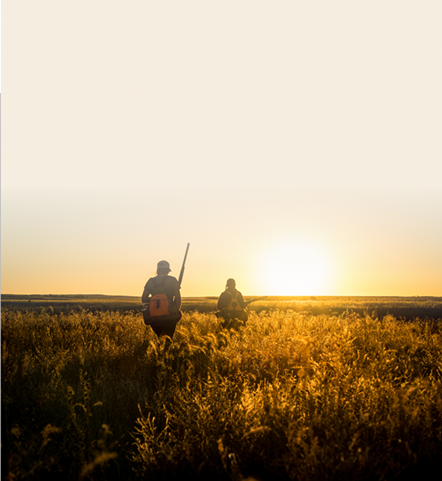
Transcript for On The Wing Podcast Ep. 335: Why Target Shooting Builds Better Hunters and Stronger Conservation Support
Speaker 1 (00:15.63)
There's moonbeams in... And there's rivers in...
I'm gonna see
Speaker 1 (00:35.854)
You
Speaker 2 (00:50.474)
Welcome to On The Wing podcast presented by Purina Pro Plan. Now this episode marks a new effort to create a shorter podcast, a snackable edition. You like that for marketing lingo? A snackable edition episode on occasion. And we are talking about this on a recent Pheasants Forever and Quail Forever content meeting within the Ord just a couple of weeks back.
and I solicited the team for snackable topic. And the first person to raise their hand was Ashley Chance, our hunting heritage programs manager. And Ashley suggested the following, how about an episode aimed at encouraging people to mentor new hunters by taking them shooting, target shooting, clay shooting, breaking some clays to create new hunters.
So here we go, we're to talk about a lifetime of enjoyment as a hunter started by breaking a clay and Ashley Chance is going to be our featured guest. Before we get rolling, I want to give a shout out once again to Purina Pro Plan, our national dog food sponsor at Pheasants Forever and Quail Forever and the presenting sponsor of On the Wing podcast. As you know, all of my pups have always eaten Purina Pro Plan.
not just because Purina supports the Wildlife Habitat Conservation Mission of our organization, which is incredibly important to me and it should be important to you. But the most important fact is Purina has a team of the world's best scientists and nutritionists behind their dog food. Purina Pro Plan was created for the bird dog like yours and like mine. You can learn more at ProPlanSport.com.
Ashley, of all, thank you. Thanks for offering up a snackable concept. Did you eat snackables growing up?
Speaker 1 (02:57.882)
my gosh. Well, Lunchables?
I think I'm getting them confused. Why don't you just stack them up? I'm definitely getting them confused.
Yes. I can tell you as an adult a Lunchable seems much more like a snackable than a meal, that's for sure.
Well, here we go. got a snackable lunchable. You pick your favorite term. Episode coming at ya. We got seven fast facts on how target shooting fits into hunting. I'm sorry, we gotta start that over. We have six fast facts on how target shooting fits into hunting. And number six, Ashley, what's number six on our topo?
Okay, before we do number six, really quick, I just wanna preface this with the reason that I had this idea was because I know mentoring a new hunter can seem insurmountable. It can seem like a huge thing to undertake. And so I wanted to reduce the burden or the perceived burden around that. So that's where this list came from. So number six, the face of target shooting is changing.
Speaker 1 (04:05.294)
So there's growing interest among women and people of color in the target shooting space, which provides us an opportunity to diversify and thus strengthen the sporting community. There's some research conducted by Southwark and Associates in 2024 that showed women, and this is across demographics, excuse me, across locations, so across the country, whether folks were urban or rural and across race. It showed that women were more motivated to start shooting.
by safety and learning new skills and personal protection. And men were driven more by the potential for fun and excitement and understanding those motivations I think can help us reach people where they are.
Do you recall how you were first introduced into hunting? Did you come in through hunting or shooting?
Well, yes.
Kyle Flatter!
Speaker 1 (04:59.022)
Yes, I do have a very vivid memory. So I grew up, I was fortunate to be born into a hunting family. grew up, my first hunting experiences were deer hunting alongside my dad, which quickly escalated into the elk hunting with him. part of that was shooting, target shooting with a rifle. And I can remember one time we were at our neighbor's house shooting rifles and they gave me
a gigantic rifle. I ultimately shot a 270 when we went hunting, but I think it was a 300 Ultra Mag. And I was sitting on a plastic lawn chair, you know, at the shooting table and I pulled the trigger and went onto the back two legs, my little 15 year old self, yeah, onto the back two legs of the chair and came back down. so that, don't recommend that. Don't do that to kids. But yeah, so shooting by way of hunting was my first experience.
Okay. Yeah, that's often the most intimidating component for new folks is that recoil. Whether we're talking about a shotgun or a rifle, the recoil and those story of you getting knocked on your key stirrer, that's what people fear.
Yeah, definitely. And for good reason, I mean, it hurts. It hurts a little bit.
Yeah, so be mindful of that if you're going to approach bringing somebody into hunting via shooting. knowing where those fears lie is one of the first steps to overcoming that and safeguarding against it. All right, number five on our tote board as well.
Speaker 1 (06:38.456)
So number five is that social acceptance of shooting and hunting directly impact legislation on both activities. So giving more people positive experiences obviously leads to lasting support for these activities among the voting public. So super important.
Very important and it's going to tie really importantly into number four here in a moment. Before that, I want to pause and thank Rainbelt Premium and Premium Light, the pheasant-friendly beer. New Pheasants Forever Camel Cases are available in stores across Minnesota, Wisconsin, Iowa, Nebraska, and both Dakotas right now. You can look for it in the orange or the blue.
camo cans with the Pheasants Forever logo on it. And today's premium moment comes to us from Rob in Washington on Facebook. And this is Rob Thornton's premium moment story. I never owned a true hunting dog before. I got my first pup, a small monster lander, three and a half years ago. I'm not a very good dog trainer myself, so the first year was train the trainer.
And after hunting North Dakota with Arrow, my pup's name, he showed me why he is smarter, or his nose is smarter than me in the field very quickly. His prime genetics in Drive really kicked in and he has become a fabulous pheasant dog, duck dog, and anything else he would point on the uplands of North Dakota.
And as of last year, he can now track deer, turkeys, or anything I point at with a simple find it commands. This year, he's been invited to be a sire for the breeder. So my two and a half year old can't wait to get him a puppy in early 2026, all the way from Alberta. What a great experience to grow a bird dog yourself.
Speaker 2 (08:50.222)
and he's become such a wonderful friend. So Rob, thank you very much for sending in the story of Arrow as a Greenbelt premium moment from the field. We've got a Greenbelt prize pack headed your way. All right, I teased number four as being connected to the impacts on legislation. Tell us what number four is on the Tote Board, Ashley.
Okay, so number four, presumably if you're listening to this episode, it's because you care about having an impact on hunting, conservation, wildlife management. So number four is that you don't have to introduce someone to hunting directly to have an impact on those things. This is because 77.5 % of Pittman Robertson dollars come from non-hunting gun and ammunition purchases. And this is research done by Selfwick and Associates, or cited by them.
I think maybe we could use a little breakdown of the Pittman-Robertson Act and how that all works. So the Pittman-Robertson Act of 1937, also known as the Federal Aid and Wildlife Restoration Act, reallocated an excise tax on ammunition, guns, and now archery to be directed towards state wildlife agencies. So it's an 11 % tax that happens on
all guns, ammunition, and archery, and those funds are allocated back to state agencies to pay for wildlife management and now also our three efforts. So that's the very quick overview of it.
Yeah, PR folks have heard it referred to as PR for I'm sure generations. It's just an incredibly important component of funding the North American model of wildlife habitat in this country and creating dollars for wildlife habitat. And know, it actually underscored 77.5 % of the dollars that go into that PR fund come from non-hunting expenses, target shooting, clay shooting.
Speaker 2 (10:56.992)
is really important for us. Obviously, the majority of the folks listening are probably hardcore bird hunters, but have some respect and understanding of what target shooting means to wildlife habitat in terms of PR funding. Really important to underscore that. All right, moving to number three on the old Tote board. Tell us what number three is, Ashley.
Speaker 2 (12:12.654)
So I'm going to take a moment here and thank Onyx. As you were talking about introducing new folks to hunting and I was looking at this Onyx spot, was thinking to myself, know, one of the hindrances to becoming a hunter is knowing where to go. And Onyx are a proud partner of the organization as well as On the Wink Podcast is a tremendous
new tool in the last decade that helps clarify where people can find public land, where they can go. We're super proud to partner with ONIX, particularly around our PATH program, Public Access to Habitat program, which has already opened up an additional 100,000 acres of high quality habitat on private lands in South Dakota and Nebraska. And new this year, it's coming in North Dakota, Oklahoma, and Michigan.
So if you're somebody curious about getting into hunting, in addition to the top six list that Ashley and I are talking through right now, a tremendous tool is Onyx. And you can go to the link in the show notes at onyxhunt.com. Use the promotional code PFQF, and you can save yourself 20 % off that membership, and Onyx will make a donation back to our Wildlife Habitat Conservation Mission.
when you use that code. So thank you to Onyx for also being a partner that helps us introduce new folks to the joys of becoming a hunter. All right, Ashley, we're at our final two. Number two on the list for why target shooting is a great way to introduce people to hunting.
Speaker 2 (14:18.658)
Yeah, that's such a great, sort of obvious, but not talked about a lot. When you go to the range, the intimidation around the firearm, not the intimidation around knowing where an animal lives. You go with somebody one-on-one, kind of. It's a very, it's a very approachable way.
put a shotgun in a person's hands in a safe manner and get them on the road to...
Speaker 2 (15:27.746)
Yeah, that's super, super important. I was almost bleeding in with my comments to number one, but I stopped myself short. And the number one reason introducing someone to target shooting is a great move for conservation. Number one on the list is what, Ashley?
Speaker 2 (16:43.574)
Yeah, yeah, and you know, one of the things that's sort of intuitive throughout this marksmanship or being an efficient shooter, it is so important to the ethics within being a hunter. We all want to be A, safe, but also B, hunting involves an animal dying. I mean, it's plain and simple. That's how you're going to get food.
on a dinner plate. we, none of us, particularly hunters who love these species, want any animal to suffer. We want as clean, as effective, efficient moment of kill as possible where it's respectful to the animal. We have the advantage as bird hunters, in most instances, having a dog as our companion and a partner.
you know, recovering game. But, you know, a lot of it is on us as an effective and efficient shooter. you know, thinking about that as part of the journey of becoming a hunter, it's super important, not just as part of the journey, but it's super important throughout the entirety. So, first of all, thank you, Ashley, for bringing this concept forward. I think we achieved snackable time. So...
folks listening, let me know in the comments. me an email, bobs at pheasantsforever.org. Do you like these snackable concepts, shortened episodes? Do you have ideas for other episodes that you'd like small bites? We know that people listen to podcasts on their commutes into work and that is a varying time and distances for everybody. So I'd to get feedback from you if you got topics.
for us to consider. So Ashley Chance, Hunting Heritage Program Manager. Did I get that right? Hunting Heritage Program
Speaker 2 (18:53.006)
All right. Thank you very much, Ashley. All right. I'm Bob Sapier, thanking you for listening and reminding you to always follow the dog. Something good will rise. Thanks, folks.