Pheasant Hunting Forecast 2023: Minnesota
COULD BE THE BEST YEAR IN MANY FOR MINNESOTA ROOSTER HUNTERS
By Tom Carpenter
Pick a Minnesota pheasant hunter at random, say, last January or February, when the state was in the throes of a monumentally harsh winter, and ask those hunters how they thought the pheasants were doing. Responses would have ranged from “not good” to “maybe wiped out.”
But never count out the ring-necked pheasant. Results of the Minnesota Department of Natural Resources annual roadside survey in August indicated a 10 percent increase statewide in 2023 (53.3 birds / 100 miles) compared to 2022 (48.3 birds / 100 miles).
What gives? Pheasants are tough, and they had enough habitat out there to help them make it through the toughest times.
“It’s great that we had as many birds come through as we did, but I don’t know I’d say it was surprising,” says Tim Lyons, Upland Game Research Scientist with the DNR’S Farmland Wildlife Populations and Research Group. “It is human nature to fear the worst for wildlife when winter gets hard, but pheasants are really tough! I fall into the camp that winter survival isn’t as important as it is sometimes made out to be. What happens to the (pheasant) population really comes down to breeding habitat conditions and weather — I tend to focus more on those factors.”
Good thing. Minnesota had a fine season for nesting and brood-rearing. All that snowmelt gave habitat a jump-start, and a warm and dry spring and summer followed – perfect brood-rearing conditions … though dry conditions and drought are beginning to reach concern levels now in many areas of the state.
The roadside count increases were not across-the board by region.
The pheasant index exhibited triple-digit increases in the Southwest region, where the index grew 101 percent over 2022, with a more modest increase in the West Central region (38 percent) versus 2022.
The Southwest (116.8 birds / 100 miles) and West Central (63.2 birds /100 miles) regions had the highest indices, followed by the South Central region (54.5 birds /100 miles). These regions should provide the best hunting opportunities in the state.
Indices in the Central, East Central, and Southeast regions decreased by 39 percent, 63 percent and 50 percent respectively. The rough winter, and a hotter summer, may have impacted birds more in the peripheral parts of the pheasant range.
Some years, weather is blamed for suppressing pheasant count numbers. Not in 2023. “Survey conditions were ideal this year. Cooler and dewy mornings, despite the drought, were ideal,” says Lyons. Believe the survey numbers.
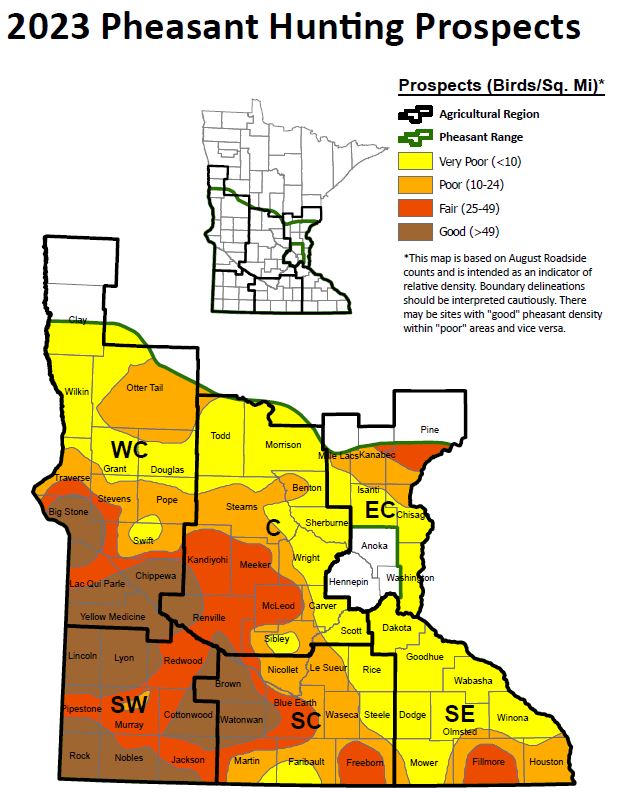
It should be a good year for pheasant hunting in Minnesota. It would almost be hard to pick a bad area to hunt in those core Southwestern West Central and South Central areas. As Lyons said, winter didn’t kill all the birds because pheasants are so tough and, as we all know in our hearts, it is nesting and brood-rearing success that makes or breaks a hunting season.
Habitat is always the answer.
MINNESOTA REGIONAL REPORTS
Let’s take our annual tour around Minnesota’s pheasant range and see what folks on the ground are saying.
Southwestern Minnesota / Scott Rall
In the 10 years I have been helping with the DNR roadside pheasant count, this is the highest number of birds I have seen on my 3 routes.
One really cool aside is that I usually see no Hungarian partridge, or very few. Every few years I will see 2 or 3 Huns. This year I saw 27. I haven’t seen that many partridge around in 15 or 20 years. I would not say they are plentiful, but they have enjoyed a substantial increase. I understand they do better the drier conditions are, and we are dry here going into fall.
That dry weather helped the pheasant hatch and provided good brood-rearing conditions. This was the first year in the last 7 or 8 that we didn’t get 10-plus inches of rain between May 10 and July 10.
The habitat down here looks spectacular. I can’t even explain it. It has been very dry. But the farmers got just enough rain at just the right times, and that helped the prairie habitat too. Still, it is dry. Lakes are low. Streams are not flowing. The ground will be crunchy if we don’t get rain. Birds are here, but they will know you are coming, so hunt smart.
Scott Rall is a Pheasants Forever stalwart and chapter leader from Worthington.
Western Minnesota Border Country / Gary Hauck
Usually I am a bit skeptical on what the roadside count numbers say for our area, but this year I can believe it. I am seeing many more birds than last year at this time.
The other day I took the dog out for a walk at a new place, and we saw 15 birds on one short stretch of field road. And those birds were all different sizes – big ones, roosters just starting to color up, and little chicks too. It was great to see. And as I drive around, I see birds on almost every road.
Last winter was harsh, for sure. We lost birds, for sure. But enough got through. And then we had these great hatch conditions. With pheasants, it is all about the hatch. May and June were nice. There were no flooding rain events. It was about perfect for nesting and brood rearing.
It is going to be a very good hunting season out here. But it is dry. I predict that, because of those dry conditions, much of the crop will be in by the opener. That bodes well for hunting.
One caution is this, though. Hunters should know that some WMA habitat has been mowed for hay due to the drought conditions, so be prepared. A drive through eastern South Dakota recently revealed similar results on the landscape there: Many CREP and other lands have been opened to haying.
PF supporter and chapter leader Gary Hauck hails from Laq qui Parle County. He picks off a few roosters most every week of the season.
West-Central Minnesota / Chad Bloom
I believe the roadside counts this year. I think they are right on the money for our neck of the “fields,” and we may even be a little better than “fair” and well into “good” here in Kandiyohi, Meeker, Pope, Stevens and Swift Counties. Southwestern Stearns too.
The biggest thing here is our fantastic habitat. Man, it looks good. You always have a chance here. The U.S. Fish and Wildlife Service’s partnership with PF does great things here, and DNR lands are ever improving for habitat. There is plenty of public and public-access land to hunt.
The corn is well along, well ahead of where it was the last few years, and I think we will see substantial harvest of the fields before the opener. It will be a big opening day, and the rest of the season should be good too.
I have been out hiking with the dogs regularly, and moving birds every time out. There aren’t any big, big broods that I have seen, but there are plenty of smaller broods, plus solo roosters. Some birds are small yet, and they will color up later in the season for a new batch of birds to hunt. You will find birds here.
Chad Bloom is a serious uplander and good friend of PF who works for the Ruffed Grouse Society. He lives in the Willmar area and keeps a pulse on the habitat and birds around his region.
Morris Area / Dave Jungst
Things are looking better now compared to what we all thought and worried about, out here in the middle of that crushing winter. Three feet of snow is usual for us but we had a lot more than that, I can’t even tell you how much. But birds made it through … enough so that we have had a good nesting season.
The weather, which has turned especially dry as of late, was ideal – warm and mainly dry -- for hatching and raising broods. All that snowmelt surely helped the habitat get a good head start in spring.
I have been seeing birds in the road ditches, and in the fields, as I travel the area for work here in Stevens, Grant and area counties. It has been very, very dry through August into September, but the conditions haven’t seemed to hinder the birds’ ability to pull off broods.
We are seeing a nice mix of bird sizes even now, on the fringe of fall – roosters coloring up, half-grown birds, and chicks on the small side … which indicates that some re-nesting has happened for birds that lost nests.
I have not seen much emergency haying around here, which is a good thing for the pheasants. I think we have had just enough rain, and at the right times, to hold that off. The habitat looks really good in spots and pockets within the fields.
If this dry pattern keeps up, we should have an early corn harvest, and that will be good for early season hunting. That grain should be dry for the producers too – we hope, a very profitable year.
I have one pretty good tip for a dry year like this. Work toward and around water sources. Creeks. Ditches. Sloughs. Lake sides. You name it. The habitat will be thicker there, and the birds will like that. On warm early season days, it is cooler there too.
I am looking forward to my second season with my little setter Ellie. She had a nice season last year at 6 months of age, and this year, with some experience under her belt, we are excited to get on some more birds. They are out there.
Out in the border country near Morris, one of the birthplaces of Pheasants Forever, Dave Jungst of the DNR’s native prairie unit, as well as a pheasant hunter and PF fan, keeps tabs on the birds for us.
Marshall Area / Troy Dale
I think it is going to be a very good season for hunters in this whole area, from Murray over to Lincoln county and the whole area. We had good conditions for running the roadside routes, and you can see the results in the DNR report.
On one route, I saw 30 to 40 more birds this year than did when running it last year, which was in itself a good year.
Then on Monday September 11 I went out for a walk, and there were broods everywhere – running around, little roosters sounding off.
Yes, last winter was hard. But wildlife, especially pheasants, are so much tougher than we humans give them credit for. Still, if you had asked me in March, I would have said we’d have a fair hunting season at best. But the hatch was good. The young birds had plenty of hoppers to eat too.
There is some emergency mowing and grazing so be aware, but the amount of that activity going on is not as significant as past years. Conditions are still very dry. Be ready to head into cattail basins, which will be dry, and work for birds.
We have already had some combining of corn goibg on, and I think the farmers will finish that off before the beans this year. That is good.
The Marshall area is popular. We are going to have birds, and we always have hunters. Be prepared to share the fields, be courteous. There is room for everybody.
Troy Dale is assistant wildlife manager for the Minnesota DNR in the Marshall area. He stays busy working, and coaching hockey for his boys, but he gets in plenty of hunting so don’t feel too sorry for him.
PIPESTONE AREA / MARTY WOLLIN
It is dry down here, and there is some emergency haying going on in CRP, but the habitat on wildlife areas is looking good.
We are seeing good numbers of broods – not as many now, but more at the beginning of summer. So it seems like the first hatch was strong. Nesting conditions were really good.
There are a lot of big roosters running around … winter survival must have been good, even though that winter was bad.
With the emergency haying happening, birds might be more concentrated in marginal habitat, so don’t overlook ditches, tree groves, odd and weedy corners, and the like.
The roadside count seems like it was right on and accurate this year for our neck of the prairie. We always have a swath of “fair” bird numbers here. Pipestone County doesn’t have as much CRP as the surrounding counties, but where there is habitat there will be birds.
Marty Wollin is longtime chapter president of Pipestone County Pheasants Forever.
PUBLIC ACCESS NOTES
If you complain about not having a place to hunt in Minnesota, you like to complain. Hundreds of thousands of acres of Minnesota’s 1.3 million acres of wildlife management areas (WMA) lands fall within its pheasant range, as do tens of thousands of acres of the waterfowl production areas (WPA). With its partners, Pheasants Forever plays a key role in securing many of these lands for wildlife, for hunting and for many other styles of outdoor recreation.
And Minnesota’s Walk-in Access (WIA) program continues to provide public hunting opportunities on private lands already enrolled in existing conservation programs or with natural habitat. The program has grown each year since inception and in 2023, and it features more than 250 sites totaling more than 29,000 acres, primarily in the South Central, Southwest, and West Central regions – pheasant country.
To start exploring all these lands, visit the Minnesota DNR’s pheasant hunting page, and spoke out from there.